
We are reader supported. When you purchase through links on our site, we may earn an affiliate commission. Also, as an Amazon affiliate, we earn from qualifying purchases.
Choosing between PSA and SGC can feel bigger than the card in your hand. Fees, turnaround time, pop reports, slab design, resale value, crossovers. Each choice nudges the outcome of your hobby and your budget. This guide strips away noise and shows where each grader shines, where it stumbles, and how to pick the right lane for your specific card and goal.
Introduction
PSA and SGC are two of the most trusted third-party graders in the hobby. Both authenticate, grade, and encapsulate trading cards, and both have global recognition. Still, they are not interchangeable. The market treats them differently. Collectors have preferences. Auction results show patterns. Your decision should reflect your card type, timeline, and exit plan. Read on and lock in a grading plan you can explain in one sentence.
PSA vs. SGC at a Glance
PSA is the market leader for modern and ultra modern cards and often commands the highest resale premiums on flagship rookies and key inserts. It has the largest population report and a long-established set registry that energizes demand. Fees are often higher, and during boom cycles turnaround can slow, but liquidity and buyer recognition are strong.
SGC is respected for speed, consistency, and a holder that many collectors prefer, especially on vintage. Its black tuxedo insert frames cards cleanly, odd sizes fit well, and its pricing is usually friendlier for bulk and budget submissions. Resale on vintage and pre-war is strong, and modern results have grown more competitive.
Both are credible. Your card and your plan decide the winner.
Grading Scales and Standards
PSA grading scale and what it means
PSA grades on a 1 to 10 scale. Half-point grades exist from 1.5 up to 8.5, and PSA also uses 9.5 to add clarity between 9 and 10. There is no pristine 10 plus tier. PSA does not use subgrades. The core pillars are centering, corners, edges, and surface. Small print defects, scratches, dimples, and edge chipping can move a card down quickly at the top end. Expect tight scrutiny at Gem Mint and above-average scrutiny at Mint.
SGC grading scale and what it means
SGC also grades on a 1 to 10 scale. SGC recognizes 10 Gem Mint and a top 10 Pristine that is rare and reserved for near flawless examples. SGC uses 9.5 to mark a Mint plus outcome. Like PSA, SGC does not provide subgrades. Evaluation pillars mirror PSA with a clear emphasis on eye appeal within the technical standards.
Vintage tolerance and eye appeal
For vintage, collectors often prefer how SGC balances technical defects with overall presentation. SGC holders elevate older stock visually and handle odd sizes well. PSA still sets records for grail vintage, but SGC demand is deep and consistent among vintage-focused buyers. For modern, PSA remains the default target for top-tier liquidity while SGC can be a smart route for speed and cost control.
Slab and Label Design
PSA look and feel
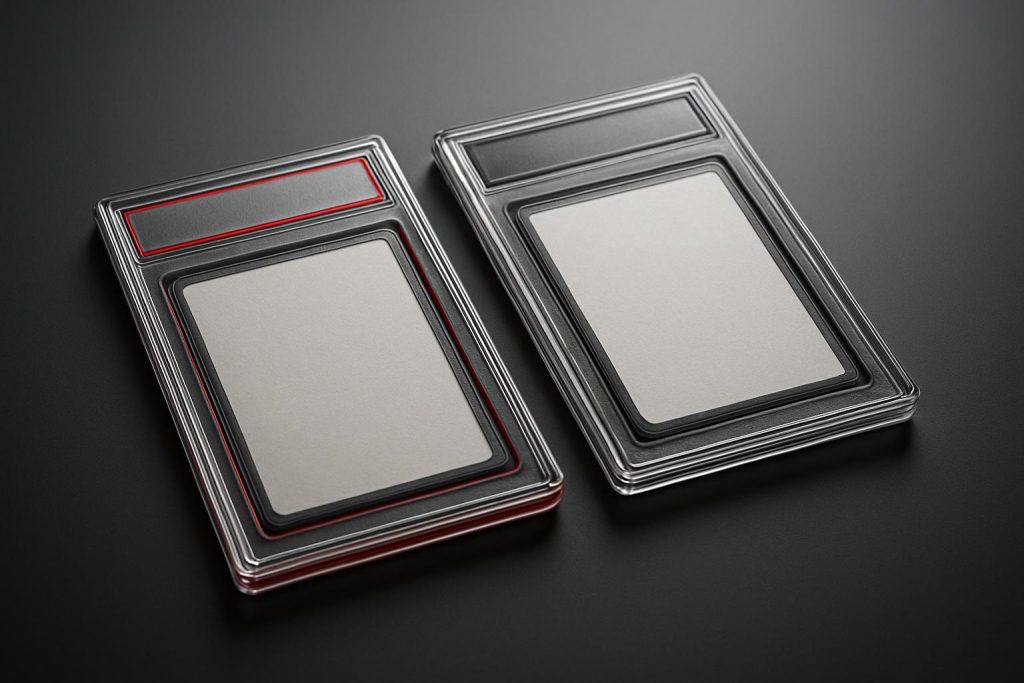
PSA slabs are clear with a simple white and red label. They are light in hand with strong clarity across the face of the card. The label carries the grade, card details, and a certification number that syncs to PSA’s database.
SGC look and feel
SGC slabs use a black insert that frames the card and reduces visual distractions from edges and borders. The result is strong contrast that many collectors love, especially on vintage, colored borders, or darker designs. The label is straightforward and the certification checks quickly against SGC’s database.
Durability and storage
Both slabs are sturdy and stack well. Both are widely accepted by insurance providers and vault services. If you plan to photograph or display, the SGC black insert often photographs cleaner, while PSA offers a bright, neutral look that works with most backgrounds.
Turnaround Time and Consistency
SGC has built a reputation for fast and predictable turnaround times, even during heavy submission periods. For collectors flipping show finds or managing frequent batches, this stability matters.
PSA can be quick at certain tiers and in stable periods, but the company has historically faced surges that slow timelines. When volume spikes, you may wait longer. When volume normalizes, timeframes improve. If you are on a deadline, SGC’s consistency is attractive. If you can afford variance to chase a potential premium, PSA is viable.
Fees and Upcharges
Pricing changes over time and is tiered by declared value for both companies. As a rule of thumb, PSA is often pricier at comparable tiers, with meaningful jumps at higher declared values. PSA may also apply upcharges if a card grades higher than expected and exceeds the tier’s value cap. SGC usually prices more accessibly, runs occasional promos, and tends to be simpler to budget for bulk or mid-range cards.
Check current rates before you submit. Build in shipping, insurance, and potential upcharges if you expect a high grade on a valuable card. If you are optimizing for total cost and speed, SGC is often the straightforward choice. If you are optimizing for top-end resale potential in modern, PSA’s premium can make sense.
Resale Value and Liquidity
Modern and ultra modern
For modern and ultra modern flagship rookies, serial-numbered parallels, and high-visibility inserts, PSA slabs often command stronger premiums at equivalent grades. Buyers see PSA 10 and PSA 9.5 as top targets, and the largest auction houses reinforce this behavior through frequent headline results. Liquidity is strong at volume, which helps if you plan to sell quickly.
Vintage and pre-war
SGC performs very well on vintage, especially pre-war, tobacco, Goudey, and early Bowman or Topps. The tuxedo holder and decades of trust in vintage authentication continue to attract bidders. PSA still sets many vintage records, but SGC pricing and velocity are competitive, and in some segments, preferred.
Mid-tier and PC cards
For player collection cards, team sets, and mid-tier modern where the difference between top comps is slim, SGC grading can yield a better net after fees and time. If you intend to keep the card and value presentation, SGC is easy to recommend. If you intend to maximize a narrow group of modern exit prices, PSA is often the safer bet.
Population Reports and Ecosystems
PSA’s population report is the largest in the hobby, and its set registry is a powerful builder of demand. Collectors chase completion and upgrades, which drives bids beyond pure scarcity. This network effect explains some of the PSA premium and liquidity.
SGC’s population report is smaller but active and growing, and its grading consistency has earned trust. For vintage, SGC population data is essential context because many of the finest examples live in SGC holders.
Crossovers and Cracking
Crossing a card from one slab to the other can work, but it carries risk. Both PSA and SGC accept crossover submissions with a minimum grade instruction. If the card does not meet your minimum, the card can remain in the original slab. Cracking and submitting raw is riskier and should be reserved for experienced hands or low-risk cards.
Expect variance at the margins. A Mint in one slab is not guaranteed to be the same Mint plus or Gem in the other. Think in ranges. If your target is a clear upgrade path that materially changes the card’s market, consider a minimum grade crossover. If the goal is a lateral move, leave it alone.
When PSA Is the Better Choice
You are targeting the highest liquidity on modern flagship rookies, serial-numbered modern hits, or high-visibility inserts. You plan to consign to large auction houses that feature PSA prominently. You are comfortable paying higher fees and potentially facing longer turnaround in exchange for a shot at the strongest modern comps. You want the largest population dataset and the benefits of the established PSA set registry community.
When SGC Is the Better Choice
You focus on vintage, pre-war, odd sizes, darker borders, or card designs that benefit from a black insert. You value fast, predictable turnaround and friendlier pricing tiers. You want to move inventory quickly without carrying grading risk for months. You like the look of the tuxedo slab in a personal collection, or you sell into communities that prefer SGC for vintage and classic sets.
Submission Strategy for Beginners
Define your outcome
Write down your main objective. Max resale on modern, smooth turnaround and low fees, best presentation for vintage, or long-term PC. This single line points you to PSA or SGC without guesswork.
Prescreen your cards
Check centering, corners, edges, and surface under good light. Use a loupe. Clean gently with a microfiber if safe. Set a minimum grade you will accept before you submit. If a card only pays at Gem and you think it is Mint, re-evaluate.
Batch with intent
Group modern high-upside cards for PSA. Group vintage, odd sizes, and mid-tier modern for SGC. Keep declared values realistic to avoid surprise upcharges. Track receipts, shipping, and timelines. Small, focused batches teach faster than giant mixed shipments.
Protect your downside
Do not submit everything. Raw is still king for low-end or damaged cards. Spend where grade can change outcomes. Hold back cards with clear surface dents, soft corners, or visible creases unless they have historical or scarcity value.
Common Myths and How to Think Instead
Myth PSA always grades tougher than SGC
Reality grading outcomes overlap and vary by card, era, and defect type. Some cards do better with PSA, others with SGC. Assume ranges, not absolutes.
Myth SGC has no resale
Reality SGC is strong on vintage and competitive on many modern segments, especially when speed and net proceeds matter. Liquidity is healthy across key categories.
Myth slab choice does not matter
Reality the market pays differently by holder and grade. Your slab is part of your exit plan.
Vintage vs. Modern Nuances
Pre-war and early post-war
SGC’s presentation and experience with odd sizes and older stock make it a natural fit. Eye appeal matters, and the tuxedo frame helps. PSA still delivers strong results for top vintage keys, but collector preference for SGC here is real.
Serial-numbered and condition-sensitive modern
PSA often secures the best premium at the top of the market. If your card is a cornerstone modern piece, PSA deserves a close look. If the card’s upside is modest and time matters, SGC can produce a better net after fees and speed.
Risk, EV, and Reality Checks
Expected value is not just the highest comp. It is the weighted outcome across grades minus all costs and time. If your card has a narrow path to Gem, graded fees are high, and timeline risk is real, SGC can be the sensible choice. If your card has a strong Gem chance and the PSA premium is clear and durable, PSA can justify the extra cost and time.
Test your assumptions with small batches. If your Gem rate misses, adjust quickly. If your timeline hurts cash flow, shift tiers or companies. Protect capital first, then chase upside.
Decision Framework You Can Use Today
If you want max modern resale
Choose PSA for flagship rookies, top inserts, and key serial-numbered modern. Submit at a tier that matches realistic declared value and timeline.
If you want speed and steady net
Choose SGC for mid-tier modern, show flips, and inventory you want back fast. Price your sales to move and recycle capital.
If you focus on vintage and odd sizes
Choose SGC for presentation, sizing options, and strong buyer demand. PSA remains viable for the very top keys but is not mandatory.
If you are building a registry set
PSA has the deepest registry ecosystem and buyer base. If the registry experience motivates you, PSA is the logical route.
Conclusion
There is no universal better. PSA is the market standard for modern liquidity and headline premiums. SGC is the smart choice for speed, cost control, and vintage presentation, with modern results that continue to impress. Start with your goal, match the grader to the card and timeline, and respect the difference between potential and probable outcomes. If you can explain your plan in one line, you are ready to submit with confidence.
FAQ
Q: Which company usually gets the best resale on modern cards
A: PSA often commands the highest premiums and strongest liquidity on modern and ultra modern flagship rookies and high-visibility inserts.
Q: Is SGC better for vintage
A: SGC performs very well on vintage and pre-war, benefits from the tuxedo holder’s presentation, and has deep, consistent buyer demand.
Q: Who has faster and more predictable turnaround
A: SGC has built a reputation for fast and predictable turnaround times, while PSA timelines can vary more during heavy submission periods.
Q: Do either PSA or SGC use subgrades
A: Neither PSA nor SGC uses subgrades; both rely on an overall 1 to 10 grade with select half steps.
Q: How should a beginner decide between PSA and SGC
A: Define your outcome, prescreen your cards, and batch with intent; choose PSA for max modern resale and SGC for speed, cost control, and vintage presentation.