
We are reader supported. When you purchase through links on our site, we may earn an affiliate commission. Also, as an Amazon affiliate, we earn from qualifying purchases.
Baseball is faster and hotter than ever, and sweat management decides comfort, focus, and late-inning performance. Moisture wicking is no longer a buzzword. In 2026 it is a full system of fibers, knits, finishes, and patterning that moves sweat off the skin, dries fast, and stays comfortable through nine innings. This guide breaks down how modern jerseys work, what numbers matter, how to buy the right one, and how to care for it so it keeps working all season.
Introduction
Players demand jerseys that feel dry, breathe well, and hold up to slides, sun, and travel. Brands respond with lighter yarns, smarter structures, and more responsible chemistry. The result is a jersey that manages moisture better from first pitch to the last out. If you are new to fabric tech, start with what wicking really means. Then learn how 2026 materials achieve it, which metrics to check, and how fit, graphics, and care can help or hurt performance. By the end, you will know exactly what to look for and what to avoid.
What Moisture Wicking Really Means in 2026
Moisture wicking is the fabric’s ability to pull sweat away from your skin, spread it across a larger surface, and let it evaporate quickly. It is not the same as breathability, which is how much air passes through a fabric. It is not active cooling either. Wicking is a transport and drying process driven by capillary action and evaporation.
In baseball, wicking matters because games involve high-intensity bursts and long intervals. Shoulder seams carry a bat, upper back takes sun, and underarms and chest build heat. If sweat sits on skin, you feel clammy and you lose precision. If sweat moves and dries, you feel stable and focused.
How Modern Baseball Jerseys Move Sweat
Fibers and Yarns
Most 2026 jerseys use polyester microfilament yarns. Each yarn has many fine filaments, which raises surface area and capillary pathways so sweat can spread and dry faster. Yarn cross-sections can be engineered with grooves or multi-lobal shapes to increase contact points and directional flow.
Some jerseys blend in nylon for extra softness and abrasion control. A small amount of elastane or mechanical stretch gives mobility without trapping moisture. Designers lean on bicomponent yarns that pair hydrophobic shells with slightly more hydrophilic cores, which helps pull moisture from skin while keeping the outer face ready to release it.
Knits and Structures
Structure is as important as fiber. Double-knit constructions provide a skin-side that wicks fast and a face-side that spreads and dries. Pique knits use raised channels to guide sweat away from hot zones. Warp knits add stability so fabric does not bag out when soaked.
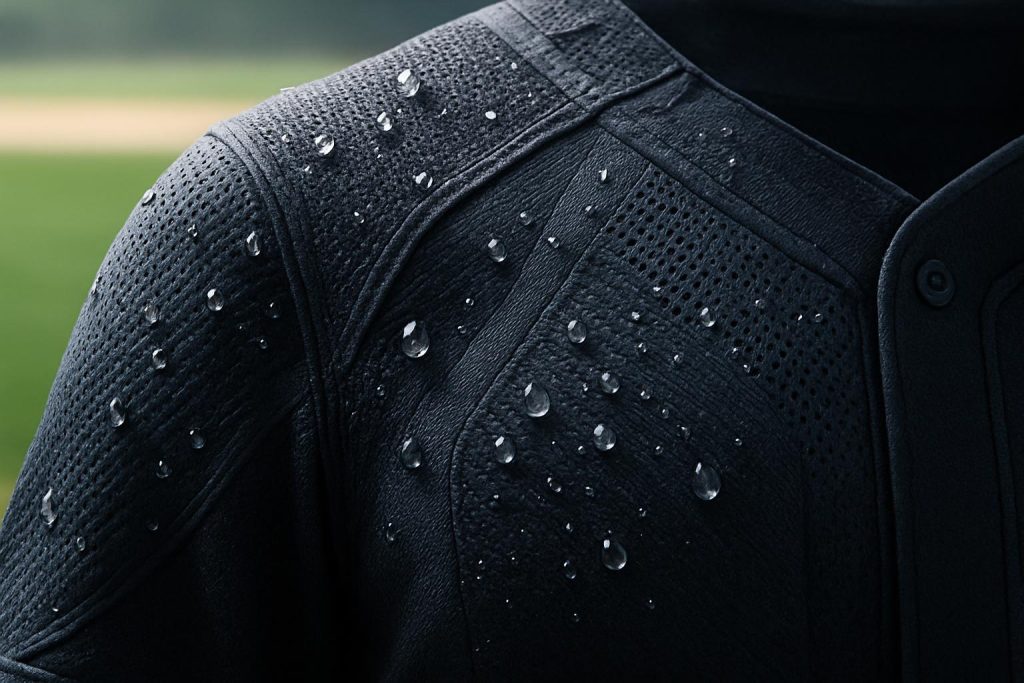
Mesh mapping is standard in 2026. Panels with higher openness appear at the upper back, side seams, and underarms. Denser knits reinforce high-wear areas like shoulders and chest where graphics and sliding stress live. Laser perforations can add targeted airflow without heavy seam buildup.
Seams matter for both comfort and moisture flow. Flat seams or bonded seams reduce bulk and chafing. Strategic seam placement keeps stitch lines off high-sweat areas, reducing wet cling.
Finishes and Coatings
Modern jerseys use durable hydrophilic wicking finishes that attract moisture at the yarn surface, speeding transfer and spreading. These are engineered to survive many wash cycles and sweat exposure. In 2026, many teams request PFAS-free durable water repellent on outer faces for light drizzle or dugout mist, while still keeping internal wicking active.
Anti-odor treatments exist but teams often choose options that avoid heavy metals and preserve skin comfort. Anti-snag and anti-pilling finishes defend against abrasion from slides, dugouts, and gear. All finishes must not clog the fabric or block pores, which would slow wicking and breathability.
The Physics Behind Wicking
Wicking relies on capillary channels created by filament bundles and knit geometry. Sweat contacts the inner surface, pulls along the yarns, spreads on the face, and evaporates. Larger spread area means faster drying even in humid dugouts. Breathability helps by moving humid air away, but even with modest airflow, good wicking speeds the first seconds after exertion, which is when comfort matters most.
Performance Metrics That Matter
Marketing claims are easy to make. Numbers clarify what you buy. In 2026, look for test-backed metrics so you can compare apples to apples.
Wicking and Drying
Wicking tests such as AATCC 197 measure vertical or horizontal wicking time and spread distance. Faster times and larger spread show better capillary action. Drying time tests measure how long fabric takes to return to baseline weight after saturation under controlled airflow and temperature. For game-day comfort, aim for fast initial pickup and quick dry within one inning’s rest.
Breathability and Moisture Vapor Transport
Air permeability per ASTM D737 (reported as CFM or L/m²/s) shows how easily air passes through. Moisture vapor transmission rate shows how well water vapor escapes through the fabric, which helps long-term dryness in humid conditions. Balance is important. Very open mesh breathes, but structure and durability must hold up under contact and graphics.
Fabric Weight and Thickness
Jersey weights typically range from 120 to 220 g/m² in 2026. Lower weights feel cooler but may snag more easily. Heavier double-knits handle abrasion and appliques but can hold more moisture if the knit is not designed to spread and dry.
Targets for 2026 Baseball Use
Use these practical ranges as buying anchors:
– Wicking time under 10 minutes to reach a 3 cm spread in AATCC 197 style tests
– Drying time under 30 minutes from saturated to baseline under standard lab airflow
– Air permeability above 50 CFM for mesh zones and 20 to 40 CFM for main body panels
– Fabric weight between 140 and 200 g/m² for a balance of structure and cooling
Specs vary by pattern and league rules, but hitting these ranges keeps you in a strong performance zone.
Zoned Construction and Body Mapping
2026 jerseys embrace zoned panels. Designers map sweat rates and abrasion zones, then assign a knit and weight to each. The result is a jersey that wicks and dries faster where you heat up while protecting seams and graphics where you need structure.
Common placements include lightweight mesh at the upper back and underarm, medium-weight double-knit at chest and shoulders, and gusseted side panels to expand movement while venting heat. Laser micro-perfs add airflow at the shoulder blades to speed shirt-to-air exchange in the dugout.
Seams, Bonds, and Comfort
Stitches can either wick with you or against you. Coverstitched or flatlocked seams reduce ridges that hold sweat. Bonded seams remove thread bulk in targeted areas, but bond tapes must be narrow and breathable to avoid blocking airflow. Seam placement stays off the underarm apex and away from bat contact lines to minimize wet friction.
Graphics Without Killing Wicking
Graphics and numbers matter for identity and compliance. They can also block pores if done poorly.
– Sublimation is the best option for wicking. Color is dyed into the yarn with almost no impact on airflow or moisture movement.
– Screen print can work well if it uses thin, breathable inks. Heavy plastisol layers reduce wicking across large logos.
– Solid vinyl heat transfers block pores and create hot spots. If you use vinyl, choose perforated styles.
– Tackle twill looks premium but adds weight and can slow drying under the patch. Mesh or perforated twill reduces the effect.
Plan logo placement away from the upper chest center and heavy sweat zones when rules allow. Spreading multiple small marks beats one large block.
Weather Strategy: Hot, Humid, and Cold Games
For hot and humid conditions, pick a jersey with higher air permeability mesh zones, microfilament yarns, and fast-drying finishes. Light colors help with radiant load, and sublimated graphics keep pores open.
For mild spring or night games, use a balanced double-knit with moderate mesh to avoid chills. If you add a baselayer, choose a thin hydrophilic knit that passes sweat quickly to the jersey. Layering only works if the first layer wicks as well as the outer one.
In light rain or mist, a PFAS-free DWR on the jersey face helps repel droplets without stopping inner wicking. Once saturated, drying time matters more than water repellency.
Durability Versus Comfort
Baseball jerseys face abrasion from slides, belts, and gear. The best 2026 fabrics blend softness with snag resistance and maintain wicking after many washes. Look for anti-snag ratings and pilling resistance. Denser stitches at hems and bar tacks at stress points prevent distortion without adding bulk. When possible, reinforce shoulders under appliques to avoid yarn breaking during repeated batting practice.
Color and Heat Management
Dope-dyed yarns bring strong color with less water use and better fade resistance, which helps keep dark jerseys cooler over time by maintaining stable reflectivity. Finishes designed for sweat fastness reduce dye bleed and keep your skin and baselayers clean. All of this supports even wicking by keeping the fabric surface consistent through the season.
2026 Innovations to Watch
– Zoned body mapping with graded porosity lets teams optimize each panel for the climate and role.
– Bonded micro-seams reduce chafe and moisture buildup while keeping stretch.
– Microfilament and bicomponent yarns increase spread area without raising weight.
– PFAS-free DWR options protect against light moisture with less environmental impact.
– Dope-dyed colors improve durability and keep pores open by avoiding heavy surface inks.
– Optional phase change additives appear in small zones for temperature buffering, but teams use them sparingly because they add weight and can slow drying if overused.
Fit, Pattern, and Mobility
Fit affects moisture management. A jersey that is too tight traps sweat and raises cling. A jersey that is too loose flaps and can pool moisture. Aim for a streamlined athletic fit with clearance at the chest and underarm to allow air exchange during rest intervals. Raglan sleeves improve mobility and move seams off the shoulder crest. Side gussets allow torso rotation for swings while creating vent paths.
Hem length matters. A slightly extended back hem stays tucked during slides, which prevents sweat pooling at the waistband. Collar design should sit flat without thick bindings that hold sweat at the neck.
Baselayer Pairing
If you wear a baselayer, it must wick as well as or better than the jersey. A thin, open-knit baselayer moves sweat to the jersey and spreads it further. Avoid cotton, which holds moisture and defeats the outer fabric. Align seams so jersey and baselayer stitch lines do not stack on hot spots.
Care and Maintenance
Good care preserves wicking. Follow this routine:
– Wash cold and inside-out with mild detergent.
– Skip fabric softener. It coats fibers and blocks capillary channels.
– Avoid bleach. It degrades fibers and finishes.
– Tumble dry low or hang dry. High heat can damage bonded seams and finishes.
– Remove promptly to prevent dye transfer and odor set-in.
– If your jersey has a water-repellent face, renew it with a PFAS-free spray only when beading fails, and avoid saturating mesh zones.
Testing and Quality Signals
Look for clear references to standards. AATCC 197 for wicking and spread, drying time protocols under controlled conditions, ASTM D737 for air permeability, and notes on colorfastness to perspiration signal real validation. Consistent performance after 20 to 30 wash cycles shows the finish is durable, not just a showroom effect.
Buying Checklist
Use this short checklist before you buy:
– Wicking time and spread: under 10 minutes for initial spread in AATCC 197 style tests.
– Drying time: under 30 minutes from saturated to baseline in lab tests.
– Air permeability: mesh zones above 50 CFM, body 20 to 40 CFM.
– Zoned panels: mesh at upper back, underarm; double-knit at chest and shoulders.
– Graphics: sublimation preferred; if using vinyl, choose perforated; keep large solid logos off core sweat zones.
– Weight: 140 to 200 g/m² for balance.
– Seams: flat or bonded in high-friction areas, sensible placement.
– Care: no fabric softener, low heat drying.
Common Mistakes to Avoid
– Choosing thick vinyl numbers that suffocate the chest panel.
– Buying a jersey that fits too tight, which increases cling and slows airflow.
– Ignoring air permeability and only reading wicking claims.
– Using fabric softener, which ruins wicking in a few washes.
– Overbuilding for cold nights and then overheating during day games.
Real-World Setup for a 2026 Season
For hot regions, choose a zoned jersey with high openness mesh at the upper back and underarm, microfilament double-knit at the chest, sublimated graphics, and a light baselayer only when needed. For cooler regions, use a slightly denser body panel, minimal mesh, and maintain sublimation or thin inks. Carry a spare jersey for doubleheaders to reset drying performance when humidity spikes. Rotate jerseys to allow full dry between games and extend wash cycles to when they are actually dirty rather than simply damp.
Sustainability and Safety
2026 jerseys push toward lower impact without sacrificing performance. Recycled polyester is common, dope-dye reduces water use, and PFAS-free water repellents are available. Certifications that screen for harmful substances give extra confidence. Avoid overly complex multi-material appliques that block recycling at end of life. Washing with a filter bag or machine filter reduces microfibre release. These decisions support performance while reducing environmental load.
Conclusion
Moisture wicking in 2026 is the sum of smart yarns, tuned knits, careful finishes, and disciplined patterning. The best jerseys move sweat quickly, breathe where you need it, and hold up under graphics and game stress. Numbers matter, but so does real fit, placement of seams and logos, and basic care. Use the metrics and checklists above to choose well and keep the fabric working its hardest when the game gets late and the heat rises.
FAQ
Q: What does moisture wicking mean in a baseball jersey?
A: It is the fabric’s ability to pull sweat away from your skin, spread it across a larger surface, and let it evaporate quickly. It is different from breathability and from active cooling.
Q: What fabric metrics should I check before buying a 2026 jersey?
A: Look for wicking time under 10 minutes in AATCC 197 style tests, drying time under 30 minutes in lab conditions, air permeability above 50 CFM for mesh zones and 20 to 40 CFM for main body panels, and fabric weight between 140 and 200 g/m².
Q: Does sublimation or vinyl numbering affect moisture wicking?
A: Sublimation preserves wicking because it does not block pores, while solid vinyl heat transfers block pores and create hot spots. Perforated vinyl or mesh tackle twill reduces the impact.
Q: How should I wash a moisture wicking jersey?
A: Wash cold and inside-out with mild detergent, avoid fabric softener and bleach, then tumble dry low or hang dry. High heat can damage bonded seams and finishes.
Q: What is new in 2026 jersey tech?
A: Zoned body-mapped panels, bonded micro-seams, microfilament and bicomponent yarns, PFAS-free DWR options, dope-dyed colors, and limited use of phase change additives in small zones.