
We are reader supported. When you purchase through links on our site, we may earn an affiliate commission. Also, as an Amazon affiliate, we earn from qualifying purchases.
Coaches who master the fungo turn routine practice into sharp, game-like work. Good fungo skills create precise grounders, clean line drives, and playable fly balls on demand. Players get the exact reps they need. Sessions move faster. Risk stays lower. This guide breaks down the essentials so you can hit better fungos today and coach with more control tomorrow.
What Is a Fungo and Why It Matters
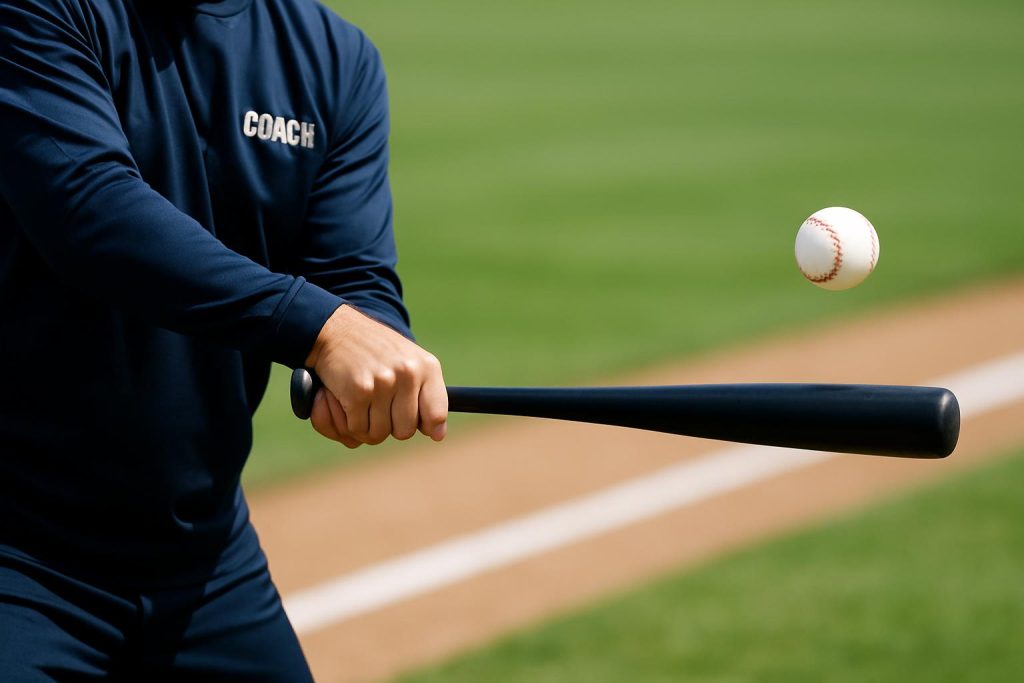
A fungo is a long, lightweight bat that lets a coach hit repeatable balls to any defender. The length gives leverage and aim. The lighter swing preserves the arm and shoulder across a full practice. With a clean self-toss and a controlled swing path, you can deliver exact speed, hop, and spin to any spot on the field.
Fungo work is not casual batting practice. It is targeted skill building. It shapes footwork, timing, angles, and throws. It can script any defensive scenario with consistency that live batting cannot match. Mastering the fungo is a core coaching skill, not a side task.
Equipment and Setup
Choosing the Right Fungo Bat
Pick a bat you can swing all session without fatigue. Most coaches do best with 34 to 37 inches and 17 to 23 ounces, light enough to swing repeatedly but long enough to control direction and spin. A balanced feel reduces forearm burn and keeps your path clean late in practice. Add a grippy tape and avoid a slippery handle.
Balls, Buckets, and Field Layout
Use clean baseballs that are matched in wear so flight is predictable. Set two buckets on the ground, one live and one for returns, close to your feet to reduce bending. Place cones to mark target lanes left, middle, and right. For infield work, set up 60 to 100 feet away. For outfield work, 140 to 220 feet gives full reads without forcing max swings.
Safety First
Use an L-screen when possible. Keep all shaggers in front of you in clear lanes. Place cones to define no-go zones. Call out targets and speed before each swing. Pause if anyone steps into your blind side. End the round if you feel rushed or out of rhythm.
Foundational Mechanics
Stance and Posture
Stand athletic with feet just wider than shoulder width. Hinge slightly at the hips, not the low back. Keep your front shoulder aimed at the target lane. Hold a light knee bend and a quiet head. Stay even or slightly open toward the target to reduce sidespin. Anchor your base and let the bat do the work.
Grip and Hand Action
Grip firm enough to control the barrel but relaxed enough to keep the wrists alive. The bottom hand guides direction and the top hand controls spin. Choke up one to two inches to tighten aim if needed. Keep the wrists quiet through contact for grounders and line drives, and allow a late release for high flies.
The Self-Toss
Hold the ball at chest height with your top hand. Toss the ball 12 to 18 inches upward and slightly forward to your hitting side so it arrives just in front of your front hip. Avoid a high toss that makes you chase or a toss that drifts across your body. Stay still until the ball reaches the peak, then begin the swing.
Contact Point and Swing Path
Meet the ball slightly in front of the front hip. Use a compact move with minimal stride. The bat path sets the outcome. A slight downward path with top-half contact creates true grounders. A level path through the middle creates firm line drives. A slight upward path with bottom-half contact creates fly balls. Finish the barrel to the chosen lane and hold your balance after contact.
Ball Flight Control
Ground Balls on Command
For a clean grounder, strike the top half of the ball with a slight downward path and a controlled finish. Keep the head quiet and the body stable. To create a one-hop, use a lower line with firm speed. To create a two-hop, reduce speed and let the ball land earlier. Adjust hop by changing entry angle and speed, not by flipping the wrists.
Line Drives with Carry
To hit a line drive, center the ball and stay level through contact. Keep the top hand firm and finish through the lane. Use this for infield reaction work and outfield reads in shallower positions. Line drives improve first-step timing and quick throws.
High Fly Balls and Deep Drives
To produce a deep fly, contact the bottom half with a slight upward path and full extension. Keep your lower body stable so you do not over-rotate. Focus on smooth acceleration, not force. Deep flies train drop steps, route angles, and long throws without needing live batting.
Shaping Spin and Direction
Backspin lifts the ball and keeps it true. Topspin brings it down sooner and increases skip speed on turf. To add backspin, stay under the ball and keep the barrel moving up along the target line. To add topspin, stay above the ball with a short finish. For direction, align the front shoulder to the lane and release the barrel to that line. For opposite-field work, delay the barrel slightly and keep the hands inside the path.
Targeted Fungo for Each Position
Corner Infielders
Work firm one- and two-hop balls to glove side and backhand. Add short reaction line drives to simulate hot shots. Mix in slow rollers that require barehand picks and quick throws. Vary depth so footwork changes from fence-side plays to infield-in reads.
Middle Infielders
Script footwork and feeds. Deliver medium-speed grounders that require clean transitions. Mix forehand, backhand, and balls slightly behind the bag. Add slow rollers for inside-out throws and on-the-run lanes. Build double-play timing with feeds at different heights and speeds.
Catcher
Train pop-ups by adding backspin and height that bring the ball back toward the plate. Mix bunts down each line with varying pace. Add short hoppers at the knees for blocks and recoveries. Include quick transfer throws to second and third to reinforce footwork and release angles.
Outfielders
Use high flies for routine reads and line drives for gap reactions. Shape balls that slice or hook to test routes. Place deeper targets to rehearse throws to cutoff and bases. Add balls hit directly over the head to simulate emergency drop steps under pressure.
Drills and Progressions
Warm-Up Progression
Start easy to build rhythm. Hit 8 to 10 grounders straight at each infielder at medium speed. Next, 6 to 8 to the glove side and 6 to 8 to the backhand. Then 4 to 6 slow rollers to each. For outfielders, begin with 6 medium-depth flies, then 4 deep flies, and 6 line drives. Keep the toss height and tempo steady.
Precision Lanes and Targets
Use three cone gates for each fielder to define left, middle, and right lanes. Call the lane before each swing. For infield double plays, place a cone above the bag as a visual feed target. For outfield cuts, set cone targets at realistic distances for the cutoff and the base. Call the speed in simple terms such as easy, game, or hard challenge.
Game-Like Sequences
Link plays together. For infield, go grounder to short, check runner, throw to first, then next swing feeds second base on a double-play turn, then a slow roller to third with throw across. For outfield, hit a ball to left-center, throw to second, then a ball down the line, throw to cutoff, then a ball to right-center, throw to third. Keep the flow smooth with clear calls.
Two-Coach Stations
When possible, run two fungo stations to cut idle time. One coach handles infielders while the other handles outfielders. Stagger swings so balls do not cross. Rotate groups after short sets to keep energy high. Use a manager or player to shuttle full and empty buckets between stations.
Counting Quality Reps
Define a quality rep as the right speed, location, and hop for the drill. Use 8 to 12 reps per set for each player, run 2 to 4 sets, and stop or reset when tempo or location slips. Quality beats volume. Keep a quick tally so every player gets even work.
Common Mistakes and Fixes
Toss too high leads to late, glancing contact. Fix it by lowering the toss and starting the swing only after the peak. Rolling the wrists early adds hooks or slices. Fix it by holding the top hand through contact and finishing down the lane. Over-swinging tires the forearms and ruins accuracy. Fix it by staying at 70 to 80 percent effort and letting the bat length do the work.
Drifting feet or turning the chest mid-swing pulls balls off line. Fix it by setting the front shoulder to the target and keeping the head still. Staring at the fielder instead of the ball causes mishits. Fix it by locking eyes on the ball through contact and only then finding the target. Inconsistent tempo breaks player timing. Fix it by pausing half a second between toss and swing to keep cadence steady.
Efficiency and Session Management
Pace, Flow, and Bucket Management
Set two buckets at your feet. Live balls in one, returns in the other. Assign a player to feed balls into the live bucket during water breaks. Set a simple cadence such as ball down, field, throw, reset. Call the next target while the previous throw is in flight. Keep sets short, around 45 to 60 seconds per player group, then rotate.
Weather and Field Conditions
Wind shifts ball flight more than you think. Into the wind, add a bit more height on flies. With the wind, back off height to avoid overcooking. Crosswind requires aiming upwind and using slight sidespin to hold the lane. Wet balls feel heavier and reduce spin; swing easier and emphasize clean contact. Indoors, lower the toss and swing more level to avoid ceilings. Use low-bounce balls if space is tight.
Advanced Fungo Skills
Opposite-Field Accuracy
To drive balls to the opposite field, close the front shoulder slightly to that lane, delay the barrel a fraction, and keep the hands inside the line of the ball. Finish the barrel directly through the lane rather than rolling over. Start with medium speed and build to game speed.
Backspin Tower Pops for Catchers
Create height without a wild drift by contacting the lower inside quadrant of the ball and finishing steep but on line with the plate. Add just enough upward path to lift the ball while keeping your posture stable. Watch the wind and adjust aim to keep the ball in the workable arc above the plate.
Rapid Short-Hop Feeds
Kneel or half-kneel to lower your release point, then use a gentle downward path to send crisp short hops. Aim chest high with a single, predictable hop. This is a clean way to reinforce soft hands and funnels without burning players out.
Communication and Feedback
Say the target, lane, and speed before each swing. After the rep, give one short cue at most. Use constraints when players need a reset, such as only backhands for this set or only one-hop throws. Praise exact behaviors you want repeated, like low chest-high hops or clean exchange to throw. Stop and reset the drill if quality drops for more than two swings.
Sample 20-Minute Fungo Plan
Minute 0 to 3: Warm-up mechanics. Easy self-toss, 8 straight grounders to each infielder, 6 medium flies to each outfielder. Focus on toss height and steady cadence.
Minute 3 to 10: Infield lanes. For each infielder, 4 glove-side, 4 backhand, 4 at them, 3 slow rollers, then 3 double-play feeds. Keep throws at realistic game pace. Call the lane each swing.
Minute 10 to 17: Outfield reads. For each outfielder, 4 medium flies, 3 deep flies, 3 line drives, 2 balls over the head. Add 2 throws to bases through the cutoff. Adjust for wind as needed.
Minute 17 to 20: Team sequence. Three quick infield grounders with throws across, then two outfield balls with throws to third and home. End with one high pop for the catcher. Debrief with one clear takeaway.
Checklist Before You Start
Confirm bat length and feel. Check two buckets and ball count. Place cones for lanes and no-go areas. Set an L-screen if available. Mark targets for feeds and cuts. Plan the order of drills and the exact rep counts. Assign shaggers and runners. Decide your cue words. Start at medium speed and build up only after accuracy locks in.
Conclusion
Fungo mastery is a system built on simple mechanics and strict control. A consistent self-toss, a stable base, a defined swing path, and clear communication produce high-value reps in less time. With the right setup and a steady cadence, you can serve the exact plays your defense needs, manage fatigue, and keep practice safe. Work the basics, layer in precision, and finish with game-like sequences. Your players will feel the difference in their reads, their hands, and their throws.
FAQ
Q: What length and weight of fungo bat should a coach use?
A: Most coaches do best with 34 to 37 inches and 17 to 23 ounces, light enough to swing repeatedly but long enough to control direction and spin.
Q: How high should the self-toss be for consistent contact?
A: Toss the ball 12 to 18 inches upward and slightly forward to your hitting side so it arrives just in front of your front hip.
Q: How do you produce a true one-hop ground ball to a fielder?
A: Strike the top half of the ball with a slight downward path, keep the head quiet, and control speed so the ball reaches the fielder on one long hop.
Q: What is a simple rep scheme that protects quality?
A: Use 8 to 12 reps per set for each player, run 2 to 4 sets, and stop or reset when tempo or location slips.
Q: What safety setup should a coach use during fungo work?
A: Use an L-screen when possible, keep all shaggers in front of you in clear lanes, place cones to define no-go zones, and call out targets and speed before each swing.