
We are reader supported. When you purchase through links on our site, we may earn an affiliate commission. Also, as an Amazon affiliate, we earn from qualifying purchases.
Want to call balls and strikes from your seat or sofa with confidence. You can. The strike zone is clear once you learn what to watch, when to judge the pitch, and which clues to ignore. This guide breaks the zone into simple parts, shows you how to read late movement, explains what catchers and umpires do, and gives you a repeatable checklist. By the end, you will see the zone the way the battery sees it and you will get more calls right in real time.
Introduction: Why fans miss the zone and how to fix it
Most fans judge a pitch by where the catcher catches it. That fails because the ball moves late, the catcher moves the glove, and the rule cares only about where the pitch is as it crosses the plate. Shift your focus to the front edge of home plate and to the batter’s stance. Add a few cues about pitch types and count context. You will start predicting calls before the umpire speaks.
What counts as a strike
A called strike is a pitch the batter does not swing at that passes through any part of the three-dimensional strike zone over home plate. That word any matters. The whole ball does not need to fit inside the box you see on TV. If any part of the ball clips any part of the zone, it is a strike. The corollary is just as simple. If no part of the ball passes through that volume and the batter does not swing, it is a ball.
There are other ways to get strikes that do not rely on the zone. A swinging strike is a strike even if the ball is outside the zone. A foul ball is a strike until there are two strikes. A foul tip that goes directly from the bat to the catcher’s glove and is secured is a strike. These are straightforward and you will hear them in the broadcast. The hard part is the called strike, and that is where most fan judgments drift. Keep reading and lock in the details that matter most.
The official zone, made simple
Width: the plate decides
The strike zone is as wide as home plate, including the black edges; if any part of the ball is over the plate, it can be a strike. Home plate is 17 inches wide. The baseball is a little under 3 inches across. That means an edge pitch can be a strike even when most of the ball looks outside from the stands or on TV. Train your eye to allow for that extra baseball width on both sides.
Height: set by each batter
Yes. The top and bottom of the zone are set by each batter’s stance at the moment they are ready to swing. The top is the midpoint between the top of the shoulders and the top of the uniform pants. The bottom is the hollow beneath the kneecap. Umpires set that window for each hitter. Taller hitters have taller zones. Shorter hitters have shorter zones. A crouch shrinks the zone. A more upright posture raises it. Watch the hitter settle before the pitch and memorize that window for the at-bat.
Depth: a real 3D box
The strike zone is a three-dimensional volume above the entire plate. Umpires judge the ball at the plate, not at the mound and not at the catcher. No part of the ball must remain in the zone after it crosses the plate. If it nicks the zone and then dives away, it is a strike. If it misses the zone and then drifts back in after the plate, it is a ball. What matters is where the ball is when it crosses the front edge of home plate, not where it is caught.
How to judge in real time
Your first key: judge at the plate, not the glove
Follow the pitch to the front edge of home plate and decide at that instant. Start the ball on a line from the pitcher’s hand to that front edge. Let it travel. When it meets the plate, decide height and width together. Then ignore what the catcher does with the glove. This single change fixes most misses.
Your second key: anchor your height to the hitter
Before each pitch, set your top and bottom lines for that hitter. Picture a horizontal band from the midpoint between shoulders and belt line down to the hollow beneath the knee. Now judge where the ball is in relation to that band when it crosses the plate. High of the band is a ball. Low of the band is a ball. Inside the band is eligible to be a strike if it also crosses the width of the plate.
From the stands: adjust for angle
Your seat location changes what you can judge well.
- Behind home plate: you can read width well and height acceptably. Follow the pitch to the plate and mark it against the hitter’s knees and belt line.
- Along the baselines: you can read height well and width poorly. Use the foul line and the outside edge of the plate as landmarks. Give edge pitches more benefit because parallax makes strikes look off the plate from the side.
- Outfield seats: you see depth but not width or height well. Focus on obvious misses and clear middle strikes. For close calls, wait for the call.
On TV: use graphics carefully
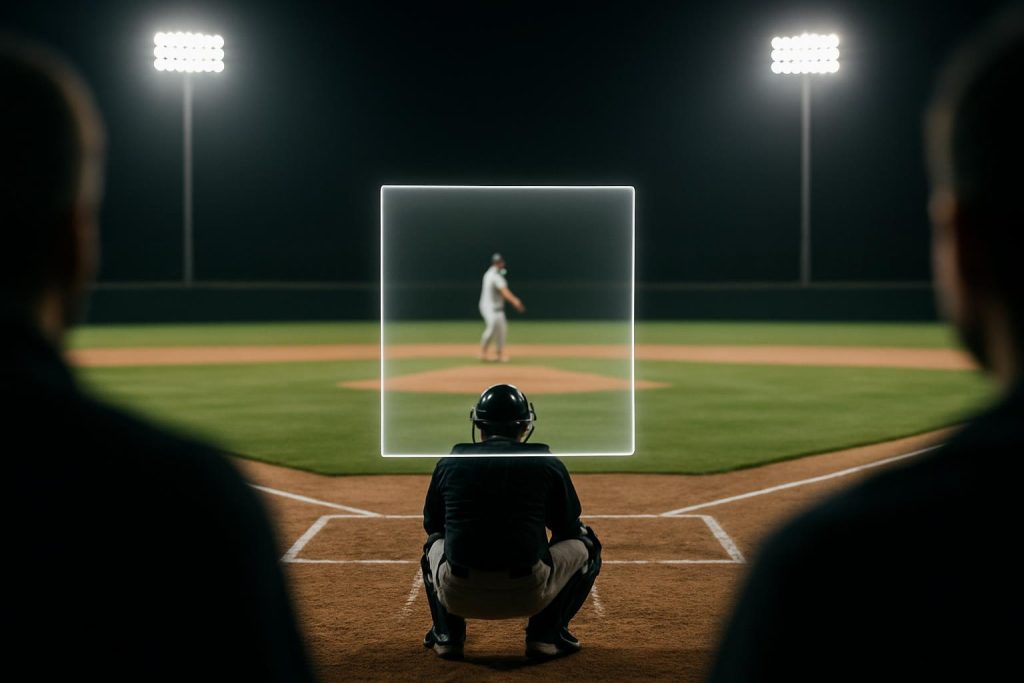
Broadcast strike zone boxes are estimates and can be off by several inches. Cameras are off center, and the zone must adjust by hitter stance. Some networks update that in real time and some do not. Use the box as a guide, not a verdict. Judge at the plate. If the pitch is near a border, expect small display errors to show up. Trust the rule and the hitter’s stance more than the graphic.
Pitch movement and what it does to your eye
Different pitches move in predictable ways. If you know the usual shape, you will know which side of the plate is at risk and where late break will fool you. Here is the fast map.
- Four-seam fastball: rides a bit and stays on line. If it starts middle and stays up, it often finishes a strike.
- Sinker or two-seamer: armside run and drop. If it starts on the inner third to a same-side hitter, expect it to finish off the plate inside or below the knees. If it starts on the outer third, expect it to run back over the black.
- Slider: glove side break. If it starts on the plate, it may leave the zone late. If it starts just off, it may clip the front corner before diving.
- Curveball: bigger drop. If it starts head high, judge it at the plate. Many curves that look high out of the hand drop into the zone at the knees.
- Changeup: speed reduction and armside fade. Starting on the plate, it can fade to the edge or below the knees. Starting off, it can come back to the black.
Adjust your call based on where the ball will be at the plate, not on the early flight path. Late break is designed to fool hitters and fans. Hold your judgment until the ball reaches the plate.
Catcher influence you should ignore and use
Framing moves the glove
Catchers receive the ball to present strikes. They pull the glove into the zone, hold it steady, and catch the ball as close to the plate as possible. This is called framing. It can influence the call even though the rule has not changed. Your job is not to follow the glove. Your job is to judge the ball at the plate. No matter where the catcher catches it, the strike definition does not change.
Targets tell you the plan
Before the pitch, the catcher sets a target. If the pitcher misses by a lot, you will see a big glove move. That big move can bias your brain into thinking ball. Reset your eye. A good pitch that missed the target can still be a strike. If the glove barely moves and the ball is at the plate in the zone, you can be confident in your call.
Umpires, tendencies, and the real rule
Umpires aim to call the rulebook zone. Human judgment shows patterns. In many counts, borderline pitches move with the leverage.
- With two strikes: many umpires call a touch more at the edges and at the knees.
- With three balls: many umpires call a touch less off the edges.
The official standard does not change. Keep your rule-based judgment first. If a pitch is right on the black or the bottom seam, be ready for the count to nudge the call a bit either way. Stay consistent in your own process and you will read the umpires over a series.
Borderline pitches and how to read the edges
The black is part of the plate
The beveled black of the plate counts. An edge pitch can be a strike if any part of the ball passes over any part of the white or the black. From the side, these look outside. From behind, these look better. Give edge pitches the allowance they deserve.
Knees and top of the zone
Fans undercall strikes at the knees. A pitch that hits the hollow beneath the kneecap is the bottom of the strike zone. If the center of the ball is at the knee caps, it can be a strike. Fans also overcall high strikes. The top is lower than many expect because it is tied to the hitter’s stance at readiness. Watch one pitch, set your lines, and hold them.
Special cases every fan should know
- Check swing: If the batter offers at the pitch and misses, it is a strike even if the pitch is outside the zone. The plate umpire can ask for help on appeals to base umpires.
- Bounced pitch: A pitch that bounces before the plate cannot be called a strike unless the batter swings.
- Foul balls: A foul ball is a strike until there are two strikes. With two strikes, a normal foul ball does not add another strike.
- Foul tip: If the ball goes sharply from the bat into the catcher’s glove and is secured, it is a strike. With two strikes, it is strike three.
Practical checklist you can use on every pitch
Before the pitch
- Set the top and bottom of the zone based on the hitter’s stance at readiness.
- Note the catcher’s target to anticipate the plan without letting it bias your call.
- Know the pitcher’s main pitch shapes to expect movement at the plate.
As the ball travels
- Track the ball on a straight line to the front edge of home plate.
- Wait to judge until the ball reaches the plate.
- Adjust for expected late break based on pitch type.
At the plate
- First, decide width: did any part of the ball pass over any part of the plate.
- Second, decide height: was the ball inside the hitter’s band from midpoint shoulders to pants and down to the hollow beneath the knee.
- If yes to both and no swing, call strike. If no to either and no swing, call ball. If the batter swung and missed, call strike.
Practicing your eye
On TV and replays
- Use slow-motion or frame-by-frame to freeze the ball at the front edge of the plate.
- Ignore where the catcher receives the ball. Look at the ball relative to the plate and to the hitter’s belt and knees.
- Compare your call to the umpire’s and to the strike zone graphic. Note any consistent offset in the broadcast graphic for that game.
At the park
- From behind home, track width first and then height. From the baselines, reverse it and give edges more allowance.
- Pick a batter early and practice setting the zone window for that one stance.
- Call out your result softly before the umpire. Build confidence with each correct read.
Common myths to drop
- Myth: The pitcher must hit the catcher’s target to get a strike. Reality: Missing the target does not change the rule. Only where the ball is at the plate matters.
- Myth: The ball must be fully inside the box to be called a strike. Reality: Any part of the ball touching any part of the 3D zone is enough.
- Myth: Where the catcher catches the ball decides the call. Reality: What matters is where the ball is when it crosses the front edge of home plate, not where it is caught.
- Myth: TV strike zone boxes are exact. Reality: Broadcast strike zone boxes are estimates and can be off by several inches.
Advanced reads: patterns and tendencies
Count leverage
Expect slight shifts on close calls with two strikes and three balls. With two strikes, pitchers aim at the edges and umpires may reward well-executed pitches at the knees and black. With three balls, pitchers aim more middle and umpires are less likely to give the border. Your job as a fan is to keep your standard steady and then note how that game’s umpire shifts at the margin.
Pitch tunneling and deception
Pitchers design sequences where different pitches share the same early path and then separate near the plate. The ball may look like a strike until the last 10 feet. Do not decide before the plate. If a pitch starts in the same tunnel and then moves off, let it go. If it starts just off and then snaps onto the black, be ready to call strike.
Putting it all together
Here is your simple system. Track the ball to the plate. Decide width by whether any part of the ball crossed any part of the plate. Decide height by whether it passed between the hitter’s top and bottom lines set by their stance at readiness. Ignore the catcher’s glove. Adjust for pitch movement at the plate. Allow for the plate’s black. Expect small human shifts at the edges with two strikes and three balls. Repeat this for every pitch and your accuracy will jump fast.
Conclusion
The strike zone is not a mystery. It is a three-dimensional rule tied to the plate and to the hitter’s stance. Once you judge at the plate and learn a few clear cues, you will see strikes and balls the same way the best catchers do. You will not need a TV box to tell you. Track the front edge, lock in the hitter’s window, and let the ball do the rest. With a little practice, you will start calling the zone in real time and enjoying every at-bat more.
FAQ
Q: What is the simplest definition of a called strike
A: A called strike is a pitch the batter does not swing at that passes through any part of the three-dimensional strike zone over home plate.
Q: Does where the catcher catches the ball determine the call
A: No. What matters is where the ball is when it crosses the front edge of home plate, not where it is caught.
Q: How wide is the strike zone
A: The strike zone is as wide as home plate, including the black edges; if any part of the ball is over the plate, it can be a strike.
Q: Does the strike zone height change with each batter
A: Yes. The top and bottom of the zone are set by each batter’s stance at the moment they are ready to swing.
Q: Can a pitch that bounces be called a strike
A: A pitch that bounces before the plate cannot be called a strike unless the batter swings.
Q: What is the best single tip for judging strikes from the stands
A: Track the ball at the front edge of the plate and judge height against the batter’s belt and knees.
Q: Are TV strike zone boxes always right
A: No. Broadcast strike zone boxes are estimates and can be off by several inches.