
We are reader supported. When you purchase through links on our site, we may earn an affiliate commission. Also, as an Amazon affiliate, we earn from qualifying purchases.
Game-used memorabilia should leave no doubt. The ball that struck the bat. The base your favorite player slid across. The lineup card pulled from the dugout wall. MLB built a system to make that certainty possible in real time, with trained authenticators, a strict chain of custody, and a trackable hologram. This guide breaks down exactly how MLB authenticators verify game-used memorabilia so you can buy and collect with confidence.
By the end, you will understand who authenticators are, what they actually witness, how the hologram code works, and what they will not certify. You will also learn how to verify an item before you buy and how to avoid common pitfalls that cost collectors money.
Introduction to MLB Authentication
What the program is
The MLB Authentication Program is the league’s official system for verifying game-used and team-issued memorabilia. Each eligible item is witnessed by a trained MLB authenticator at the ballpark, marked with a tamper-evident hologram, and recorded in a secure database that fans can search by code.
Why MLB built it
Before this program, buyers relied on guesswork and after-the-fact opinions. MLB replaced that uncertainty with on-site verification, clear chain of custody, and a public record tied to a unique hologram code. The result is a primary-source record for the hobby.
Key terms you will see
Game-used means the item was used on the field of play during a specific game. Team-issued means the club prepared the item for potential use, but it did not see live play. Player-worn means a player wore the item, such as a jersey or cap, but it may or may not have been used in live play. Authenticators record these distinctions in the database entry.
Who MLB Authenticators Are
Training and assignment
MLB authenticators are trained professionals assigned to games and league events. They are present at the stadium, follow league protocols, and observe items as they are used or removed from play. Their job is to confirm facts on the spot and document them accurately.
Independence and role
Authenticators operate under league rules and cannot certify an item they did not personally witness or control through a documented chain of custody. They do not assign market value, and they do not give opinion-based approvals. Their authority comes from direct observation and procedure.
The Verification Workflow, Step by Step
1. Pre-game setup
Authenticators arrive before first pitch for a briefing with team staff. They review any planned item rotations, such as base swaps, and note potential milestones that might need extra documentation. They confirm access to dugouts, clubhouses, and secure work areas where items can be logged and stickered.
2. In-game observation
During the game, authenticators observe the movement of items in and out of play. When a ball is taken out of play, a bat breaks, or a base is swapped, bat boys, ball attendants, or clubhouse staff route the item to the authenticator. If an item cannot be tracked from the field to the authenticator without interruption, it will not be certified.
3. Chain of custody
Chain of custody is the backbone of the program. The authenticator only certifies what they control from field to database. If a fan catches a foul ball and takes it home, MLB cannot authenticate it after the fact. If a ball is returned to the club and the authenticator confirms the chain, it can be authenticated. The same rule applies to bats, bases, and other equipment.
4. Applying the hologram
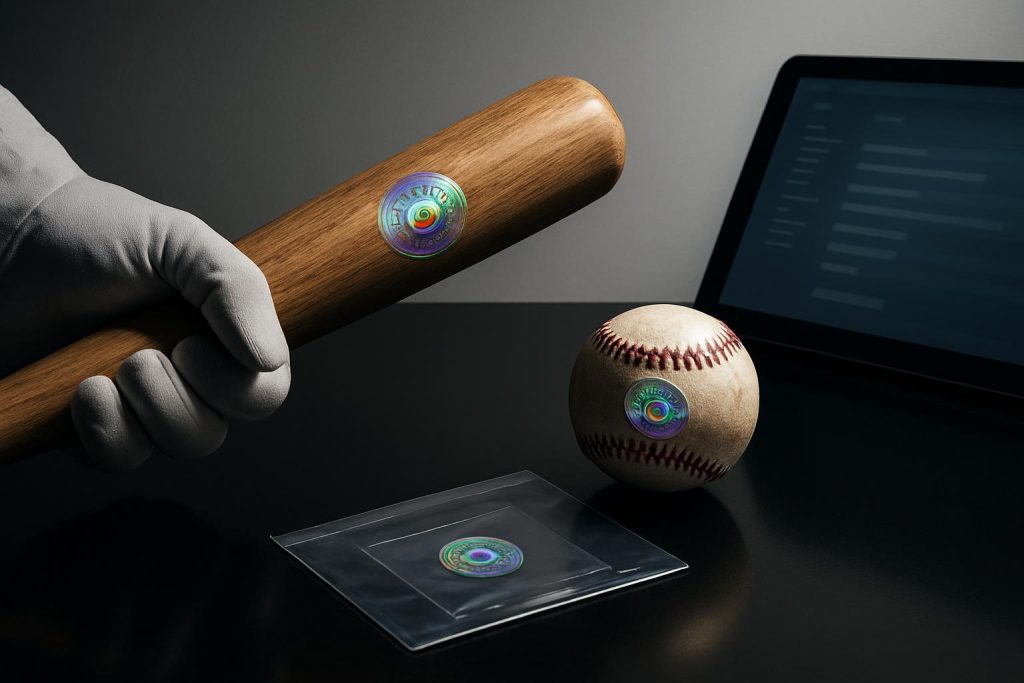
Once verified, the authenticator applies a tamper-evident hologram label with a unique code to the item, usually in a standard location that will not interfere with display. The label is designed to show damage if removed. Each code is one-time use and tied to a single database entry.
5. Data entry in real time
The authenticator enters details into the league system. Typical fields include game date, ballpark, teams, item type, inning or time of removal, relevant players and play description when known, and whether the item is game-used, team-issued, or player-worn. The entry becomes the permanent public record fans retrieve by code.
What Gets Authenticated
Baseballs
Baseballs are removed from play for many reasons. A foul tip marks up the cover, a pitch hits the dirt, or a ball exits the field. When the ball is taken out of play and routed correctly, the authenticator logs it, applies the hologram, and records context such as pitcher, batter, and inning when available. If a ball is associated with a notable play and the authenticator can confirm it, the entry reflects that detail.
Bats and broken bats
Bats can be authenticated when removed from play, including broken barrels and handles. The authenticator confirms the player, model, and game details, then applies the label. Cracks and ball marks remain as evidence of use, but the hologram and database serve as the official verification.
Bases and home plate
Bases are often swapped during the game at set intervals. Each base pulled from the field can be authenticated with date, teams, and innings of use. For special events, commemorative base jewels or plaques may be present. Home plate is not swapped during a game, but it can be authenticated after removal when replaced.
Lineup cards and equipment
Dugout and umpire lineup cards, helmets, caps, catcher gear, and other on-field items can be authenticated when the authenticator confirms their use or issuance. Not every item is eligible every game. Eligibility depends on whether an authenticator can witness and document the item according to protocol.
Real-World Scenarios
Foul ball into the stands
A batter nicks a pitch and the ball sails into the crowd. A fan brings it home. MLB will not authenticate that ball unless the club regains possession and the authenticator can confirm the chain of custody from field to authentication. Without that chain, the item remains a souvenir without MLB verification.
Home run milestone
When a milestone is possible, clubs and authenticators coordinate in advance. If the home run ball is retrieved by the team and the authenticator confirms the chain, the database entry can reflect the milestone. If the ball never returns to club control, MLB will not authenticate it.
Jersey after the final out
After a game, a player may swap jerseys or donate one to the team store or an auction. If the authenticator is present, confirms which jersey was worn, and controls the handoff, the item can be recorded as game-used or player-worn as appropriate. If the authenticator cannot confirm those facts, no game-used label will be applied.
The Hologram, Explained
Tamper-evident design
The MLB hologram is a security label that shows visible damage if removed. It uses a unique alphanumeric code tied to a single database entry. The label is placed where it adheres well and remains visible for verification without blocking the item’s key features.
The code and how to verify
Every hologram code can be entered on the league’s verification website. You can also scan it when a QR option is present. Verification returns the official record that describes the item and the context of its use. If the code does not resolve to a record, do not proceed with a purchase until you can verify it.
What the database entry includes
The record typically lists the game date and ballpark, the teams, the item type, whether it was game-used, team-issued, or player-worn, the inning or time removed, involved players or play description when known, and any special notes such as a milestone. This entry is your certificate of authenticity.
What Authenticators Do Not Do
No opinion-based approvals
MLB authenticators do not render opinions after the fact. They certify what they witness and control during the game. They do not rely on photo matching or later analysis to declare an item game-used.
No grading or pricing
Authenticators do not grade condition and do not set value. They do not appraise rarity. They only record facts tied to time, place, and use.
No after-the-fact chain of custody
Once an item leaves controlled custody, it cannot be authenticated by MLB later on. This protects the integrity of the system and the collector community.
How to Buy and Verify Safely
At the ballpark
Team stores often sell game-used items on the day of the game or soon after. Ask to see the hologram code before purchase. Verify the code on your phone. Confirm the database entry matches the seller’s label and price tag description. If anything does not match, ask staff to resolve the discrepancy before you pay.
Online purchase checklist
Request the hologram code and a clear photo of the label. Verify the code and read the entire database entry. Confirm all details match the listing, including game date, teams, item type, and usage. If the seller will not provide the code, treat that as a red flag and move on.
Red flags to avoid
- No hologram and no code
- Code that does not verify in the database
- Description that exceeds what the database states
- Story based on memory rather than a code-backed record
- Damaged or peeled hologram
Caring for Your Hologrammed Item
Storage tips
Keep the hologram clean, dry, and away from heat and abrasive surfaces. Use a display case for baseballs. For bats and jerseys, avoid friction on the label area. Do not try to move the hologram. Once the label is damaged or removed, it cannot be replaced, and the item loses its verifiable link.
Common Misunderstandings
Reused hologram myth
MLB holograms are one-time use. Once applied, a label cannot be removed and reused without visible damage. Each code points to one item in the database.
Database edit myth
Sellers cannot alter the official database entry. What you see when you verify the code is the league record tied to that hologram. If a detail appears wrong, contact the seller and the club or the league to review. Corrections, when warranted, are handled by authorized personnel, not by private sellers.
Team-issued versus game-used
Team-issued items are legitimate and often desirable, but they are not game-used. The database entry will state which category applies. Base your price and expectations on that difference.
Why the System Works
Primary-source verification
The program relies on direct observation and immediate data entry. That removes guesswork and replaces it with a traceable record from the field to your collection.
Consistency at scale
Because authenticators follow the same procedures league-wide, buyers see consistent entries and terminology. That consistency supports fair pricing and better trust across the hobby.
Advanced Notes for Serious Collectors
Details that add clarity
Specifics matter. For baseballs, look for pitcher, batter, and inning when present. For bats, confirm player, model, and whether the bat is cracked or broken. For bases, check which innings the base was used. For jerseys, see whether it is game-used or player-worn and note the opponent and date.
Context versus hype
Rely on the database entry, not seller embellishment. If the record lists a generic foul ball, treat it as such, even if the seller claims an extraordinary play. If the entry documents a milestone or a specific plate appearance, that detail becomes part of the item’s provenance.
Auctions and team events
Teams and league partners often sell authenticated items through official auctions. The same rules apply. Verify the code, read the full entry, and confirm the description matches the listing. Official channels reduce risk but still reward attention to detail.
Putting It All Together
Checklist before you buy
- Obtain the hologram code
- Verify the code in the league database
- Match every detail to the listing
- Confirm game-used versus team-issued versus player-worn
- Inspect photos for the hologram location and condition
- Store and display to protect the label after purchase
Conclusion
MLB authenticators verify game-used memorabilia by witnessing items in real time, controlling the chain of custody, applying a tamper-evident hologram, and entering a detailed record in a public database. The process is straightforward and reliable when you know how to read it. Use the code, read the entry, and rely on the facts. With that approach, you can build a collection that holds its story and its value.
FAQ
Q: What is the MLB Authentication Program and why does it matter?
A: It is the league’s system for verifying game-used and team-issued items through on-site authenticators, a tamper-evident hologram, and a public database entry. It matters because it replaces guesswork with a primary-source record.
Q: How do MLB authenticators verify a game-used baseball during a game?
A: They observe the ball being removed from play, maintain chain of custody from field to authentication, apply a tamper-evident hologram, and enter game details like date, teams, and inning into the database.
Q: Can MLB authenticate a ball that a fan caught in the stands?
A: Not unless the team regains possession and the authenticator can confirm an unbroken chain of custody. Without that chain, MLB will not authenticate it.
Q: What does the hologram code reveal when I verify it?
A: It returns the official record with game date and ballpark, teams, item type, usage category such as game-used or team-issued, inning or time removed, involved players or play description when known, and any special notes.
Q: What is the difference between game-used and team-issued in MLB’s system?
A: Game-used means the item was used on the field during a specific game. Team-issued means the club prepared the item for potential use, but it did not see live play. The database entry states which category applies.