
We are reader supported. When you purchase through links on our site, we may earn an affiliate commission. Also, as an Amazon affiliate, we earn from qualifying purchases.
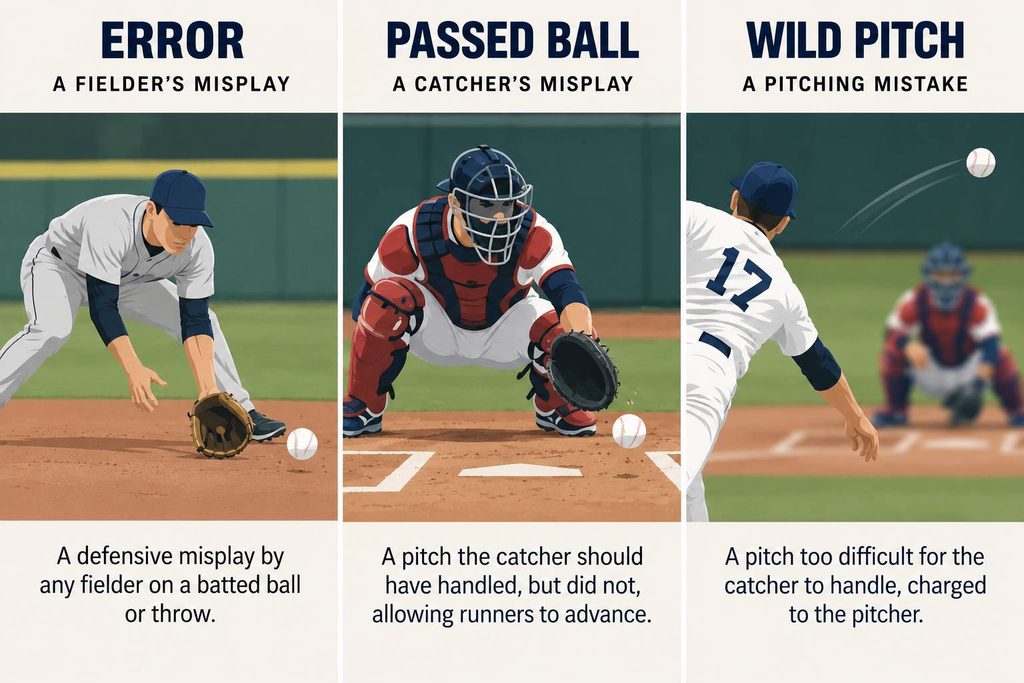
An error (E) and a passed ball (PB) are both defensive mistakes in baseball, but they are recorded differently.
The simplest distinction is:
| Error | Passed Ball | |
|---|---|---|
| Charged to | Any fielder | Catcher only |
| Usually involves | Fielding, catching, throwing or another defensive play | A legally pitched ball |
| Standard | Ordinary effort | Ordinary effort |
| Counts as an error in fielding stats? | Yes | No |
| Can contribute to an unearned run? | Yes | Yes |
| Scorebook abbreviation | E | PB |
A passed ball may look like an error by the catcher, but MLB does not record it as an error. It is a separate statistic.
And if a pitch gets away because it was too difficult for the catcher to handle with ordinary effort, it isn’t a passed ball at all.
It is a wild pitch (WP), which is charged to the pitcher.
What Is an Error in Baseball?
MLB charges a fielder with an error when, in the official scorer’s judgment, the fielder fails to make a play that an average fielder at that position should have made with ordinary effort.
An error can also be charged when a poor defensive play allows a runner to advance.
Common examples include:
- A shortstop boots a routine ground ball.
- An outfielder drops an ordinary fly ball.
- A fielder makes a bad throw that allows a batter or runner to advance.
- A fielder drops a foul ball and gives the batter another chance to hit.
That last example is important.
A batter does not necessarily have to reach base for an error to occur. MLB specifically notes that dropping a foul ball that extends an at-bat can result in an error.
What Does “Ordinary Effort” Mean?
This phrase is central to both errors and passed balls.
MLB defines ordinary effort as the effort an average fielder at that specific position and competitive level should make, taking field and weather conditions into account.
So the question isn’t:
Could this particular Gold Glove shortstop have made the play?
It is closer to:
Should an average fielder at this position and level have made it?
That is why a difficult diving play can go for a hit even when the ball touches a defender’s glove, while a routine ground ball that goes through a fielder’s legs can be scored an error.
What Is a Passed Ball?
A passed ball (PB) can be charged to the catcher when he fails to hold or control a pitch that, in the official scorer’s judgment, should have been handled with ordinary effort, and a runner advances as a result.
For example:
Runner on second.
The pitcher throws a normal fastball that the catcher should handle.
The catcher fails to control it, the ball rolls away and the runner advances to third.
Scoring: Passed Ball (PB).
The catcher is responsible for the advance.
But importantly:
The catcher is not charged with an error.
MLB tracks PB separately from E.
Passed Ball vs. Wild Pitch
This is actually the more important comparison for a passed ball.
Both involve a pitch getting away from the catcher and allowing advancement.
The difference is who the official scorer considers responsible.
Passed Ball
The pitch should have been handled with ordinary effort.
Responsibility: Catcher
Wild Pitch
The pitch was too difficult for the catcher to handle with ordinary effort.
Responsibility: Pitcher
MLB describes this as the key distinction between the two statistics.
For example:
Fastball hits catcher’s glove and gets away
→ Could be PB if it should have been controlled.
Breaking ball bounces well in front of home plate and shoots away
→ More likely WP if an ordinary catcher could not reasonably control it.
Simply touching the catcher’s glove does not automatically make something a passed ball.
The official scorer still applies the ordinary-effort standard.
Error vs. Passed Ball vs. Wild Pitch
Here is the easiest way to remember all three:
| Play | Who is responsible? | Recorded as |
|---|---|---|
| Shortstop boots routine grounder | Shortstop | E6 |
| Outfielder drops routine fly | Outfielder | E7/E8/E9 |
| Catcher makes bad throw after catching pitch | Catcher as fielder | E2 |
| Catcher fails to control catchable pitch and runner advances | Catcher | PB |
| Pitch is too difficult to control and runner advances | Pitcher | WP |
This also explains an important catcher scenario.
Suppose a runner attempts to steal second.
The catcher receives the pitch cleanly but then throws the ball into center field.
That is not a passed ball.
The catcher already handled the pitch.
The subsequent bad throw is a defensive play, so the scorer may charge the catcher with an error (E2).
Who Decides Error, Passed Ball or Wild Pitch?
The official scorer.
The umpire determines what happened during play—safe, out, strike, ball and other rules decisions.
The official scorer determines whether the statistical result should be recorded as an error, passed ball, wild pitch, hit and so on.
This is why borderline PB/WP rulings can involve judgment.
Both errors and passed balls rely heavily on the same concept:
ordinary effort.
Does a Passed Ball Count as an Error?
No.
This is probably the most important misconception to eliminate.
MLB explicitly states that:
A passed ball is not recorded as an error.
Instead, PB is tracked as its own catcher statistic.
MLB’s basic scorekeeping notation reflects this separation:
E = Error
PB = Passed Ball
WP = Wild Pitch
So a catcher can finish a game with:
0 errors
but still have:
1 passed ball.
Those aren’t contradictory statistics.
How Do Errors and Passed Balls Affect Earned Runs?
Errors and passed balls have something important in common:
They can result in unearned runs.
MLB defines an unearned run as a run that scores because of an error or passed ball, subject to the official scorer’s reconstruction of the inning.
Suppose:
- Two outs
- Runner on third
- Catchable pitch gets away
- Runner scores
- Batter later makes the third out
If the scorer determines the run would not have scored without the passed ball, the run is unearned.
The same general logic applies to an error.
Important: It Is Not Simply “PB = Unearned”
The scorer reconstructs the inning without the misplay.
If subsequent events establish that the runner would have scored anyway, earned-run treatment can depend on that reconstruction.
So the correct rule is:
Errors and passed balls can cause runs to become unearned.
Not:
Every run associated with an error or passed ball is automatically unearned.
What About a Wild Pitch?
A wild pitch is different because it is charged to the pitcher rather than treated like a defensive error or passed ball.
That means a run advancing and eventually scoring because of a wild pitch can remain earned.
This distinction is one reason PB vs. WP matters beyond simply assigning blame.
It can affect the pitcher’s ERA.
Can a Batter Reach First on a Passed Ball?
Yes, in an uncaught-third-strike situation when the rules permit the batter to run.
MLB notes that when the catcher fails to catch strike three and the batter reaches first safely, the play must be classified as either a passed ball or wild pitch, depending on who was responsible for the pitch getting away.
For example:
Two outs.
Strike three is thrown.
The pitch is catchable, but the catcher fails to control it.
The batter runs safely to first.
The pitcher can still be credited with the strikeout while the catcher receives a passed ball.
That can produce the unusual-looking box-score situation where:
Pitcher gets K
and
Batter is safe at first.
Does a Runner Get a Stolen Base on a Passed Ball?
Usually, no.
If the runner advances because the ball gets away on a passed ball, MLB does not credit a stolen base.
But there is an important exception.
If the runner was already attempting to steal when the pitch became a PB or WP, the official scorer can still credit the stolen base when the runner’s advance is attributable to the steal attempt rather than the misplay.
So don’t use:
PB = never a stolen base
as an absolute rule.
Example 1: Ground Ball Through the Shortstop
The batter hits a routine ground ball directly at the shortstop.
The shortstop fails to field it cleanly, and the batter reaches first.
If the official scorer determines an average shortstop should have made the play with ordinary effort:
Result: E6
The batter receives no hit.
This is an error, not anything involving a passed ball, because the ball was already put into play.
Example 2: Catchable Pitch Gets Away
Runner on second.
The pitcher throws a normal pitch within the catcher’s reasonable handling range.
The catcher fails to control it and the runner reaches third.
Result: PB
The catcher receives a passed ball, but not an error.
Example 3: Pitch Bounces Far From the Catcher
Runner on second.
The pitcher spikes a breaking ball well in front of home plate. It kicks far away, and the runner advances.
If the scorer determines the pitch could not have been handled with ordinary effort:
Result: WP
The pitcher receives a wild pitch.
Example 4: Catcher Throws the Ball Away
Runner attempts to steal second.
The catcher catches the pitch normally and then makes a wild throw into center field.
The runner reaches third.
The scorer may record:
SB to second + E2 allowing advance to third.
This is not PB because the catcher successfully handled the pitch itself.
Example 5: Dropped Third Strike
Two outs.
The pitcher throws strike three, but the catcher fails to control the pitch and the batter reaches first.
If the pitch should have been handled:
K + PB
If the pitch was too difficult to handle:
K + WP
MLB explicitly recognizes both possibilities.
A Simple Decision Test
When you see a defensive misplay, ask these questions in order.
1. Was it a pitch?
If no, you’re not dealing with PB or WP.
A fielding or throwing misplay may be an error.
If yes, continue.
2. Did the pitch get away and allow advancement?
If yes, decide between PB and WP.
3. Should an average catcher have handled it with ordinary effort?
Yes → Passed Ball
No → Wild Pitch
That’s the basic scoring logic.
Frequently Asked Questions
What is the main difference between an error and a passed ball?
An error is a defensive misplay charged to a fielder.
A passed ball is specifically charged to a catcher for failing to control a pitch that should have been handled with ordinary effort when that failure allows advancement.
Is a passed ball an error?
No.
MLB records PB separately from errors.
What is the difference between a passed ball and a wild pitch?
A passed ball is considered the catcher’s responsibility. A wild pitch is considered the pitcher’s responsibility. The official scorer uses the ordinary-effort standard to distinguish them.
Does touching the catcher’s glove automatically make it a passed ball?
No.
The scorer determines whether the pitch should have been controlled with ordinary effort. Glove contact alone does not decide the classification.
Can a passed ball cause an unearned run?
Yes. If the official scorer determines that a run would not have scored without the passed ball, it is unearned.
Can an error cause an unearned run?
Yes. The scorer reconstructs the inning without the error to determine whether the run should be earned or unearned.
Does a runner get a stolen base on a passed ball?
Not when the runner advances because of the passed ball. However, if the runner was already attempting to steal, the scorer may still credit a stolen base depending on the play.
Can a catcher get an error instead of a passed ball?
Yes.
A catcher can receive a normal fielding error—for example, on a bad throw to second or a dropped throw during a tag play.
Passed ball applies specifically to failing to control a pitch under the PB scoring rule.