
We are reader supported. When you purchase through links on our site, we may earn an affiliate commission. Also, as an Amazon affiliate, we earn from qualifying purchases.
Sports fans do not like to feel helpless. When a game swings against their team, they look for a switch they can flip. In baseball, one of the most famous switches is the Rally Monkey. It is a scoreboard prompt, a shared joke, and a small burst of belief that a comeback is still alive. The Rally Monkey is also a gateway into a bigger topic that every arena and ballpark lives with on game day: stadium superstitions. These rituals sit between psychology and showtime. They do not add runs or points on the scoreboard, but they change how it feels to be there. They organize noise. They shape memory. They keep crowds engaged when pressure climbs. This guide breaks down how the Rally Monkey started, why it works, and what it teaches us about the way fans and teams build energy together.
What Stadium Superstitions Are Really About
Stadium superstitions are repeatable rituals fans and teams adopt because they believe the patterns line up with winning. They include chants, props, clothing choices, seating habits, and in-game scoreboard prompts. They give people a plan at the exact moment control feels scarce. That sense of control is the key. Rituals tidy the chaos of sport into steps you can take now. Stand up. Spin a towel. Flip your cap inside out. Make noise on two strikes. These steps turn anxious waiting into active support.
There is also a social side. When thousands of people do the same thing, a private habit becomes a public wave. The wave creates timing. Timing creates drama. Drama creates attention and noise. Even if no one can prove a superstition changes outcomes, the routine can change what players and coaches hear and feel. That influence is real enough to matter on game day.
A Short History of Fan Rituals
Rituals in sports are old and cross every level. College football crowds stand the entire game and chant on third down. NHL fans wear white for a whiteout in the playoffs. Soccer ultras have choreographed songs and tifo banners. In baseball, the rally cap has been a dugout and bleacher habit for decades. Fans turn caps inside out when their team trails late. None of these actions hit or pitch the ball. But they create a sense that the crowd is doing its part. The Rally Monkey follows that tradition. It is a playful, specific signal tied to one team and a particular set of comeback memories.
The Rally Monkey Origin Story
The Birth in 2000
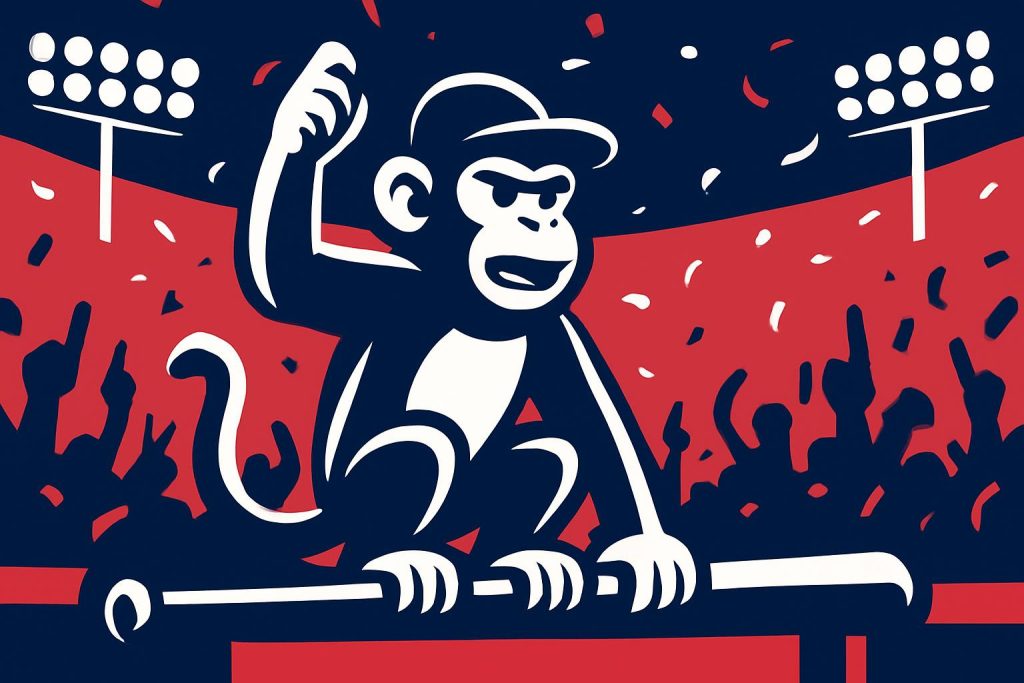
The Rally Monkey started at an Angels home game in 2000. The team’s video crew showed a quick clip of a monkey bouncing on the scoreboard with a message that called for a rally. It was a simple gag layered on a tense spot in the game. The crowd popped. The operator tried it again later. Soon the ballpark had a reusable tool for late innings. The team expanded the idea with custom footage and a capuchin monkey named Katie, who filmed scenes in an Angels jersey that could be edited into in-game prompts.
The 2002 Postseason and a New Identity
The Rally Monkey turned iconic during the 2002 playoffs. The defining moment was Game 6 of the World Series. The Angels trailed the Giants 5–0 in the seventh inning. The Rally Monkey appeared. Fans roared alive. The team chipped away, took the lead, and won 6–5. They closed the series the next night. From that point on, the Rally Monkey was not just a scoreboard bit. It was part of the club’s identity. The team leaned into it with merchandise, in-park videos, and a consistent game script that saved the monkey for high leverage moments.
How the Rally Monkey Works on Game Day
Timing and Leverage
The Rally Monkey is not a first inning toy. It is a fourth quarter or late-inning button. Operators save it for when the trailing team has a real chance to flip a game. That window is often a late at-bat with runners aboard, a pitching change with the heart of the order due, or a turning point like a replay challenge. Timing matters. If you overuse it, the effect dies. If you hit it when tension peaks, the crowd snaps to attention.
Visuals and Sound
Success needs a clean visual and a sound bed that gets people moving without extra instruction. The Angels pair the Rally Monkey with high energy music that fans recognize in the first bar. The board package is short, bold, and readable from the cheapest seats. It never asks the crowd to decode anything. It tells them what to do in one beat: rally now. Good fan prompts follow the same rules.
What Fans Do in Response
Fans have learned a menu of actions. They get on their feet, put on rally caps, and wave towels. They scream on the next pitch. They clap in rhythm between deliveries. The Rally Monkey is the call. The crowd is the response. The response then loops back into the game environment as extra noise, a delay for the pitcher to reset, and a stronger home field spine.
Why Superstitions Feel Powerful
Control in an Uncertain Game
Sports are built on randomness. Even the best hitters make outs most of the time. Superstitions give structure to that randomness. A fan can flip a cap or hold a towel and feel tied to the outcome. That feeling reduces stress and keeps people engaged instead of quiet and tense. The engagement raises the sound floor in the building. The rising floor becomes a factor coaches must manage.
Shared Attention and Collective Energy
When a whole section does the same thing, attention aligns. Aligned attention speeds up reactions. People clap faster. Chants sync. Noise peaks at key pitches. This coordination makes moments feel bigger and more intense. The Rally Monkey is a pre-set cue that fuses attention, so the crowd peaks on command.
Pressure on Opponents
Opponents hear the spike and feel the shift. Pitchers may take more time. Defenders may rush throws. Even if the performance effect is small, the cost to create the pressure is tiny. A thirty second video and a music cue are cheap. The payoff is a measurable lift in decibels and a sense that something has changed. That sense can be enough to tilt one decision in a close game.
Comparisons With Other Stadium Superstitions
Rally Cap Across Baseball
The rally cap is the most universal baseball superstition. Fans and players turn caps inside out when trailing late. It is light, visual, and has a clear meaning. The Rally Monkey and the rally cap often overlap. The video cue triggers the cap flip and the next surge of noise.
Terrible Towel in Pittsburgh
The Pittsburgh Steelers have the Terrible Towel. Fans whirl yellow towels to lift noise and signal confidence. It is simple, portable, and easy to scale to an entire stadium. The Rally Monkey works within a ballpark’s AV system. The Terrible Towel works from the stands. Both condense emotion into a clear action.
Octopus in Detroit Hockey
The Detroit Red Wings have a long playoff tradition of octopus throwing. It is less common now because modern arenas protect ice quality and safety. The core idea remains the same. Fans want a symbol that says this building is different in the postseason. Teams now look for safer, reusable props and on-screen rituals to create that same spark.
College Traditions and Sound Walls
Mississippi State fans ring cowbells. Many colleges have third down chants, stripes or whiteouts, and coordinated card stunts. All of these build a wall of sound on demand. The Rally Monkey is a baseball version that taps the same psychology with a tighter, late-inning focus.
What the Numbers Do and Do Not Say
No scoreboard prompt guarantees a hit or a stop. There is no proof that a superstition, on its own, changes win probability in a repeatable, isolated way. But there is clear evidence that home crowds can raise noise and create communication friction for opponents. The Rally Monkey is a reliable way to push noise to a higher level at the right time. That is the clean way to think about it. It does not cause a comeback. It creates the ideal stage for one.
The Business Side of Superstitions
In-Venue Production and Consistency
Production teams map out a run of show. They plan moments for hype videos, defense prompts, and special bits. The Rally Monkey sits in the late-game drawer for when the script calls for it. Consistency teaches fans what it means. If you want a ritual to stick, use it in the same context until the crowd anticipates it before it appears. Anticipation is proof the habit has taken hold.
Sponsorship and Merchandise
When a superstition becomes part of team identity, it can support merchandise and partnerships. T-shirts, hats, and towels extend the ritual into daily life. The key is to protect meaning. Sponsors should amplify the moment, not own it. The product should support the fan action, not distract from it.
Content Beyond the Stadium
Clips of the Rally Monkey travel well on social media. A short, loud, repeatable video is easy to share. It fuels second screen engagement and keeps casual viewers aware of what happens inside the ballpark. Teams build library footage that can be cut fast for game scripts and posted within seconds of a turning point. This is part of modern operations. The superstition becomes content fuel.
The Digital Era Effect
Remote Rituals
Fans at home mimic in-stadium habits. They stand for two strikes. They flip rally caps. They post videos to team hashtags when the cue hits on TV. The superstition crosses the walls of the venue and becomes a network effect. The network effect pays off in broadcast sound as well. Producers can lean into the moment with tighter cuts, crowd shots, and audio mix choices that spotlight the surge.
AR, Apps, and Live Data
Teams now blend rituals with tech. Push alerts can notify fans when the Rally Monkey appears. AR filters can let people place the monkey in their room. Live win probability charts can frame the stakes of the at-bat that follows. Used carefully, these tools deepen attention rather than split it. The rule holds: simple, fast, familiar, and timed to leverage.
How to Build a Superstition for Your Team
Step 1: Pick a Clear, Visual Symbol
Choose something fans can recognize in under one second. Animals, simple logos, or strong colors work. Avoid clutter and inside jokes. The symbol should play on a scoreboard and on a towel with equal power.
Step 2: Tie It to a Moment
Pick one or two in-game contexts where you always use it. Late-inning rallies. Third downs. Power plays. Be specific. The brain loves patterns. Patterns make rituals sticky.
Step 3: Build a Short, Loud Cue
Combine a fast visual with a music hit that the crowd knows. Keep it under fifteen seconds. Think in beats, not sentences. The cue should start the crowd, not talk to it.
Step 4: Teach the Action
Give fans a job. Stand. Spin. Clap. Flip. Keep it physical and visible. Once fans learn the job, stop telling them and let them take ownership.
Step 5: Protect Scarcity
Do not spam the moment. If every at-bat uses the cue, none of them feel special. Save it for leverage so the building has a real second gear.
Step 6: Extend with Merch and Media
Offer a prop that fits the action and looks good on camera. Share clips quickly on social platforms. Replay the moment in highlights to reinforce meaning.
Step 7: Measure and Adjust
Track when you play the cue and what happens next. You do not need to prove causation. You want to learn which contexts create the strongest, cleanest crowd response. Use that feedback to refine timing and content.
Etiquette and Safety
Keep It Fun and Respectful
Chants and props should lift your team rather than target individuals with abuse. The best rituals are inclusive and easy for families and new fans to adopt. Focus on your moment, not on taunting opponents with personal attacks.
Follow Venue Rules
Modern arenas restrict items that can cause delays or hazards. Throwing objects, blocking views, or using banned noisemakers can cost your team a penalty or ejection. Superstitions thrive when they fit within the event plan and keep everyone safe.
What the Rally Monkey Teaches
Make Belief Visible
The Rally Monkey turns a belief into a visible, shared event. It tells the crowd that a comeback is still a rational hope. That cue shortens the path from doubt to participation.
Reduce Friction to Act
Good rituals remove steps. No one needs to ask what to do when the monkey appears. People stand and shout. That clarity is why the bit lasts across seasons and rosters. Keep friction low and adoption stays high.
Connect Story to Moment
Fans remember the 2002 comeback. New fans learn it from highlights and from people around them. The story loops into every new rally. The ritual carries the old memory into the next chance. That loop is how team culture compounds over time.
Conclusion
The Rally Monkey is more than a cute clip. It is a case study in how stadium superstitions organize energy. A ritual does not swing the bat. But it gives thousands of people a job to do at the right time. That job heightens sound, focus, and memory. When teams respect timing, protect scarcity, and teach a simple action, they can build a tradition that lasts through roster changes and coaching cycles. In the end, the value is not magic. It is participation. The Rally Monkey works because it makes belief active, fast, and shared. That is what every stadium superstition aims to do.
FAQ
What is the Rally Monkey?
The Rally Monkey is an Angels scoreboard prompt that calls for a late-inning surge, using quick monkey clips, high energy music, and a clear message that rallies the crowd to stand, make noise, and believe a comeback is possible.
When did the Rally Monkey start and why did it stick?
It began in 2000 as a simple scoreboard bit and became iconic in the 2002 postseason, especially after the Angels rallied from a 5–0 deficit in Game 6 of the World Series, which cemented the Rally Monkey as part of the team’s identity.
Does the Rally Monkey actually help teams win?
There is no proof it directly changes outcomes, but it reliably lifts crowd energy and noise at key moments, creating a tougher environment for opponents and a sharper focus for the home team.
How do stadiums decide when to show the Rally Monkey or similar prompts?
Operators save them for high leverage spots such as late innings with runners on, critical at-bats, pitching changes, or other turning points when the crowd can make the most impact.
What are some other well-known stadium superstitions?
Common examples include the baseball rally cap, the Pittsburgh Terrible Towel, the Detroit hockey octopus tradition, college football cowbells at Mississippi State, and playoff towels or whiteouts that create coordinated walls of sound and color.