
We are reader supported. When you purchase through links on our site, we may earn an affiliate commission. Also, as an Amazon affiliate, we earn from qualifying purchases.
Baseball looks simple from the stands, but the scorebook tells the real story. Three symbols carry more weight than most: K, backwards K, and E. Learn them well and you can follow any game with confidence, explain what just happened in one line, and slice the action into clean, comparable data. This guide gives you a clear, practical path from zero to fluent. You will see when to use each symbol, how to write them correctly on a scorecard, how they affect stats, and how to avoid common mistakes that frustrate new scorers.
Why These Symbols Matter
Scorekeeping is a language. The right symbol locks a play into memory, ties it to official stats, and helps you reconstruct an inning in seconds. K and backwards K separate swinging from looking. E separates clean hits from misplays. Those distinctions affect earned runs, pitcher lines, batting lines, and the feel of the game. If you get them right, everything else falls in place faster.
The Basics: What K, Backwards K, and E Mean
K: Strikeout Swinging
K means the batter struck out swinging. The bat came through the zone on strike three and missed or fouled into the catcher’s glove on a two-strike foul tip that was securely caught. You record an out for the batter and a strikeout for the pitcher. On a normal caught third strike, the ball is live but the batter is out immediately. You mark K in the batter’s box on the scorecard and credit an out.
Backwards K: Called Strikeout
Backwards K means the batter took strike three. No swing, the umpire called it. Scorers draw a reversed K or write the note K looking. It still counts as a strikeout for the pitcher and an out for the batter. The backwards K helps you scan a line quickly to see who was passive at the plate versus who was aggressive.
E: Error
E means an error. A fielder failed to make a play that should have been made with ordinary effort, and that failure allowed a batter or runner to reach or advance. You always tag the fielder’s position number with the error: E6 for shortstop, E5 for third base, E9 for right field, and so on. Errors affect base advancement, outs on the board, and whether runs are earned or unearned.
Fielding Number Map You Will Use Constantly
Scorekeeping numbers for defensive positions are standard:
1 pitcher, 2 catcher, 3 first base, 4 second base, 5 third base, 6 shortstop, 7 left field, 8 center field, 9 right field.
Use these with E to identify the responsible fielder. E6 is an error by the shortstop. E3 is an error by the first baseman. Keep it automatic and you will score faster.
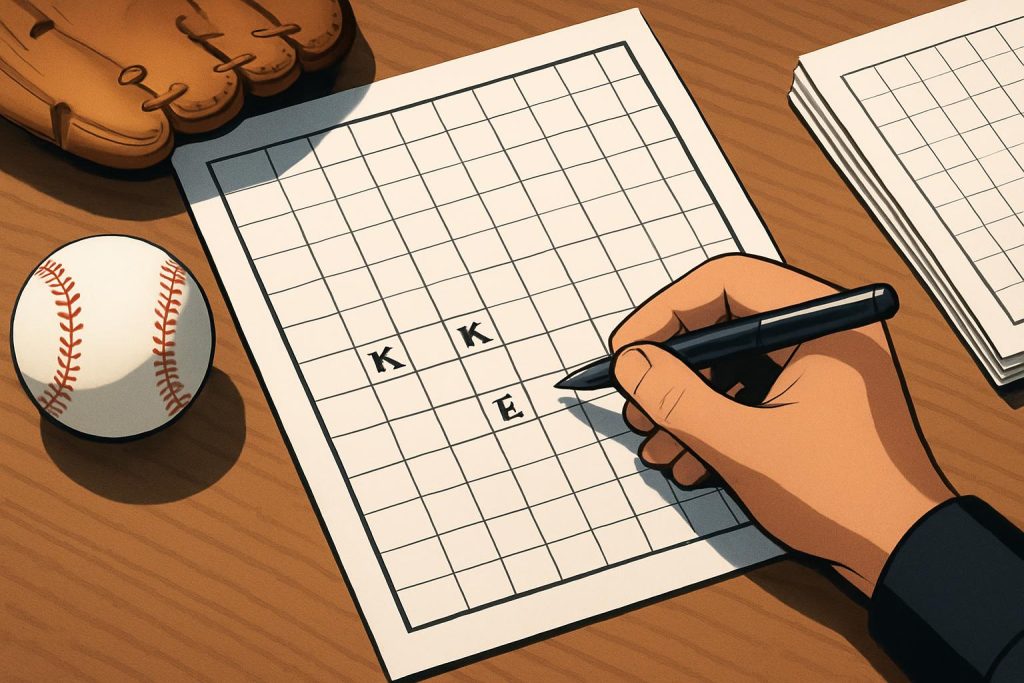
How To Mark Them On a Scorecard
Where To Place the Symbol
Each batter has a box for each plate appearance. Write K or backwards K in the center of the box when the strikeout ends the at-bat. Draw the out number in the corner if your sheet uses it, such as marking 1 for the first out of the inning. For errors, write E with the fielder number near the play notation and show where the runner ended up with base paths or small notes such as to 2B or to 3B.
Adding Context Without Clutter
Keep the main symbol clean, then add small notes if needed. You can mark looking to clarify a backward K if you cannot draw a reversed letter cleanly. For example, K looking in small print. If a runner advanced due to the error, draw a short arrow or tiny note next to E6 to 2B. Use consistent marks so you can re-read your card later.
When a Strikeout Still Requires a Throw
On a dropped third strike, the batter can try for first if first base is unoccupied with two outs, or at any time with two outs. If the catcher completes the play by throwing to first, record the putout as 2-3 and still record a strikeout. Many scorers write K and then 2-3 to show the assisted putout on the dropped third strike. If the catcher’s throw pulls the first baseman and the batter reaches, the at-bat is still a strikeout but the runner is safe. If the catcher should have handled the pitch and failed, you record K with E2. If the pitch was not reasonably catchable, it is a wild pitch; many scorers note K and WP. If the catcher should have handled it cleanly, it is a passed ball; scorers note K and PB. Keep your focus on K and E first, then add WP or PB only if you track those.
Variations You Will See
Some scorekeepers underline a backwards K. Others circle E6 for a two-base error. Pick a style and be consistent. The official essentials never change: K or backwards K for strikeouts, E plus a position number for errors. Detail beyond that is optional and dependent on your league’s guidelines.
How These Symbols Affect Stats and Box Scores
For Batters
A strikeout counts as an at-bat and not a hit. It lowers batting average and does not help on-base percentage. A batter who reaches on an error reaches base but does not receive a hit. Reaching on error does count as an at-bat, so it lowers batting average and does not increase on-base percentage. Your scorecard should reflect that difference so the box score adds up correctly.
For Pitchers
Ks add directly to the pitcher’s strikeout total. A called strikeout or a swinging strikeout both count equally in the line score. If a run scores following an error, the pitcher may avoid being charged with an earned run, depending on the reconstructing of the inning without the error. Keep the K total clean. Your E notations help you and others later when deciding earned versus unearned runs.
For Fielders and Team Defense
Each E assigns responsibility. One error does not ruin a game, but tracking them highlights trends. E5 on routine grounders signals a third baseman’s throwing issue. E9 on balls in the gap could reflect positioning or footwork. In your book, consistent E notation helps coaches and players target real problems.
Earned vs Unearned Runs In Plain Terms
An earned run is one that scores without the aid of errors or passed balls, by reconstructing the inning as if the errors or passed balls did not happen. If your E is accurate, you can quickly tell whether a run is likely earned or unearned. Wild pitches are the pitcher’s responsibility, and passed balls are the catcher’s responsibility. Errors by fielders can also turn earned runs into unearned runs depending on timing and base states.
When To Use E Versus a Hit
Ordinary Effort Is the Standard
An error is charged when a fielder fails to make a play with ordinary effort and that failure lets a runner or batter reach or advance. If the play required a difficult dive, a long run, or a barehand on a slow roller with no realistic chance, it is not an error. Score a hit in those cases if the batter would have reached safely with ordinary effort applied.
Plays Where No Error Is Charged
If a fielder attempts a play on a different runner and the batter-runner reaches safely, that is a fielder’s choice, not an error. If a fielder loses a ball in the sun with no practical way to track it, many scorers do not charge an error. If a throw is late but accurate and the runner beats it, that is not an error. If the ball takes a severe bad hop with no reasonable adjustment, that is typically not an error.
Throwing Errors Versus Fielding Errors
Distinguish between a misfielded ball and a bad throw. If the shortstop boots a grounder, record E6. If the shortstop fields cleanly but air-mails first, it is still E6. If the first baseman cannot handle a catchable throw, that is E3. The letter E is the same, but the position number must point to the responsible fielder.
Two-Base Errors and Advance Notation
When a misplay allows a batter or runner to take extra bases beyond what would have been expected, still write E with the fielder number and note the base the player reached. For example, a line single that skips under an outfielder’s glove and lets the batter go to second can be scored as a single with E9 advancing to 2B if the advancement would not have happened without the misplay. Keep the notation short and precise.
Reaching On Error and Its Effects
Write ROE in small letters if you like, but E with the position number and the runner advance is enough. The batter gets an at-bat, no hit, and the team gets a baserunner. The pitcher may avoid an earned run if that runner later scores and the inning would have ended without the error.
Combining Symbols In Real Plays
Strikeout Plus Dropped Third Strike
Scenario: Two outs, nobody on. Pitcher throws strike three swinging, catcher drops it. Batter sprints to first and is thrown out. Record K and 2-3 for the out. The pitcher gets a strikeout, the batter is out at first on the completed play. If the throw pulls the first baseman off the bag and the batter is safe, record K with E2 and place the runner at 1B.
Strikeout With Wild Pitch Or Passed Ball
If the pitch was not reasonably catchable and the batter reaches first, record K and note WP. If the pitch was catchable and the catcher failed to handle it and the batter reaches, record K and PB. Use these only if you track them, but keep your focus on the primary symbol K and the base outcome.
Error That Extends the Inning Before a Big Hit
Two outs, routine grounder to third, throw sails high. Record E5 and place the runner at first or second as appropriate. If the next batter hits a double that scores the runner, your E5 may turn what looks like an earned run into an unearned run when reconstructing the inning. The E notation is not just a detail; it governs run classification.
Common Mistakes and How To Avoid Them
Mixing Up K and Backwards K
Do not write plain K for a called strike three. Use backwards K or write K looking. This small difference helps you evaluate plate discipline and swing decisions.
Overusing Error On Tough Plays
Errors require ordinary effort. Do not punish a defender for a play that would beat most players. If the fielder had to range far, throw on the run, or deal with a bad hop that left no good option, score a hit if the batter would have reached anyway.
Forgetting the Fielder Number
Always pair E with a position number. E by itself is incomplete. E6 tells you who misplayed it. That detail drives analysis later.
Ignoring the Aftermath of a Dropped Third Strike
Many new scorers stop at K and forget to show whether the batter was retired with a 2-3 putout or reached first. Always document the final base state. If a runner reached, your next batter starts with that runner on the correct base.
Not Distinguishing Throwing Versus Fielding Errors
Note which defender failed and whether it was the field or the throw. E6 on a throw is still E6, not E3. The first baseman gets E3 only when the throw was catchable and the first baseman failed to handle it.
Fast Reference: When To Use Each Symbol
Use K when the batter swings through strike three and the catcher secures the ball or the out is completed at first on a dropped third strike. Use backwards K when the batter takes strike three. Use E plus a number when an ordinary-effort play fails and that failure allows a batter or runner to reach or advance.
Sample Plays You Can Practice
Play 1: Clean Strikeout Swinging
Batter swings and misses strike three, catcher secures it. Mark K. Add the out number if you track outs in boxes.
Play 2: Called Strike Three With Runner On First
Batter takes strike three. Mark backwards K. Runner stays on first unless a separate play occurs. No throw needed.
Play 3: Dropped Third Strike, Batter Safe
Two outs, strike three in the dirt, catcher blocks but cannot handle, batter reaches first. If the pitch was not reasonably catchable, mark K and WP. If it was catchable and mishandled, mark K and PB or K with E2 if the catcher commits a clear error on the throw or tag.
Play 4: Ground Ball, Misplayed by Shortstop
Routine grounder to short, ball clanks off the glove, batter reaches first. Mark E6 and place runner at 1B. That plate appearance counts as an at-bat for the batter, not a hit.
Play 5: Hard Infield Single, No Error
Chopper with no chance for a play even with clean fielding, batter beats it out. Mark 1B, not E. Errors require ordinary effort failure, not any failure.
Play 6: Single Plus Outfielder Misplay for Extra Base
Line single to right, the ball skips past the right fielder allowing the batter to take second. Mark 1B and E9 with advancement to 2B. The batter is credited with a single. The extra base comes from the error.
Digital Scorekeeping Tips
Most scoring apps offer buttons for K, looking, and errors with fielder selection. Select K for swinging and K looking or backwards K for called strikes. When marking an error, make sure you select the correct fielder number, not just the position name. For dropped third strikes, choose the out at first if the batter is retired, or mark the runner safe with the right cause. Review the play summary before confirming so your inning totals stay accurate.
Build a Consistent Scoring Style
Set a Simple Legend
Decide how you will show backwards K if you cannot draw it cleanly. Decide how you will note advances on errors. Decide whether you will track WP and PB. Write your legend on the card’s margin and stick to it game after game.
Keep the Main Symbols Clear
Prioritize the primary symbol first. K or backwards K in the center for strikeouts. E with a number for errors. Add extra marks only if they improve clarity. Too much detail crowds the box and makes it hard to audit later.
Review Between Innings
Take ten seconds between innings to confirm outs, bases, and symbols. If something feels unclear, fix it while the memory is fresh. A clean book at the third inning is much easier to maintain than one you try to fix in the eighth.
Troubleshooting Tight Calls
Borderline Plays at First
If the throw beats the runner but pulls the first baseman off the bag and the first baseman should have handled a better throw, charge E to the thrower. If the throw is true and the first baseman drops it, E3. If the runner simply beats a perfect throw, no error.
High Bounces and In-Between Hops
Bad hops that leave no reasonable play usually do not produce an error. Use your ordinary effort test. If most shortstops would not make that play, score a hit.
Relay Throws
If the first throw is clean but the relay is wild and allows extra advance, charge the error to the relay fielder. Identify the exact fielder with the position number and note the base reached.
Connecting Symbols to Strategy
Backwards Ks tell you if a lineup is getting frozen by strikes in the zone. Ks tell you if hitters are expanding the zone or simply missing hittable pitches. Es tell you which defenders are creating traffic. When you can scan a page and see patterns in seconds, you can adjust lineups, practice plans, and in-game tactics. The symbols are small, but the decisions they inform are large.
Conclusion
Master K, backwards K, and E, and your scorekeeping will jump from scattered notes to sharp, trustworthy records. Use K for swinging strikeouts, backwards K for called strikeouts, and E with the position number for errors based on ordinary effort. Place the symbol cleanly, add only the context you need, and check your work between innings. With these habits, you will follow any game with clarity, explain every run that scores, and turn a busy field into a clean, readable story on paper.
FAQ
Q: What does K mean in baseball scorekeeping?
A: K means the batter struck out swinging, and it counts as a strikeout for the pitcher and an out for the batter.
Q: What is a backwards K?
A: A backwards K marks a called strikeout when the batter takes strike three without swinging.
Q: What does E6 mean on a scorecard?
A: E6 means an error by the shortstop that allowed a batter or runner to reach or advance.
Q: How do you score a dropped third strike?
A: Record K, then show the outcome. If the batter is retired at first, add 2-3. If the batter reaches and the pitch was not reasonably catchable, note K and WP. If it was catchable and mishandled, note K and PB or K with E2 if the catcher commits an error on the throw or tag.
Q: Does reaching on error count as a hit or affect on-base percentage?
A: Reaching on error counts as an at-bat and not a hit, and it does not increase on-base percentage.