
We are reader supported. When you purchase through links on our site, we may earn an affiliate commission. Also, as an Amazon affiliate, we earn from qualifying purchases.
Major League Baseball officially introduced the Automated Ball-Strike (ABS) Challenge System for the 2026 season.
But MLB has not replaced home-plate umpires with robots.
The plate umpire still calls every pitch. If a batter, pitcher, or catcher believes a ball-strike call was wrong, that player can immediately challenge it. Hawk-Eye tracking technology then determines whether the pitch was inside or outside MLB’s automated strike zone.
Each team starts with two challenges. A successful challenge is retained, while an unsuccessful challenge costs the team one challenge.
In other words, MLB chose a hybrid system: human umpires make the calls, and technology corrects selected mistakes.
What Is ABS in Baseball?
ABS stands for Automated Ball-Strike System.
MLB experimented with two versions before introducing the technology in the Major Leagues:
- Full ABS: Technology determines every ball and strike.
- ABS Challenge System: The plate umpire makes the original call, and eligible players can challenge it.
MLB ultimately chose the challenge model.
That is why calling the 2026 system “robot umpires” can be misleading. Technology does not automatically determine every pitch.
How Does the MLB ABS Challenge System Work?
The process is designed to happen quickly.
The plate umpire first calls the pitch normally. If an eligible player disagrees, the player must immediately request a challenge by tapping their cap or helmet.
Hawk-Eye then checks the pitch against MLB’s ABS strike zone. The result is displayed in the stadium and the original call is either confirmed or overturned.
Only three players can initiate a challenge:
- Batter
- Pitcher
- Catcher
Managers and coaches cannot challenge a ball-strike call.
Players also cannot wait for someone in the dugout to study a replay before deciding. The challenge must be made immediately.
How Many ABS Challenges Does Each Team Get?
Each team begins the game with two challenges.
If the challenge is successful, the team keeps it.
If the original call is confirmed, the team loses one.
That means a team making accurate challenges could use ABS more than twice during a game.
If a team reaches an extra inning with no challenges remaining, it receives one challenge for that inning.
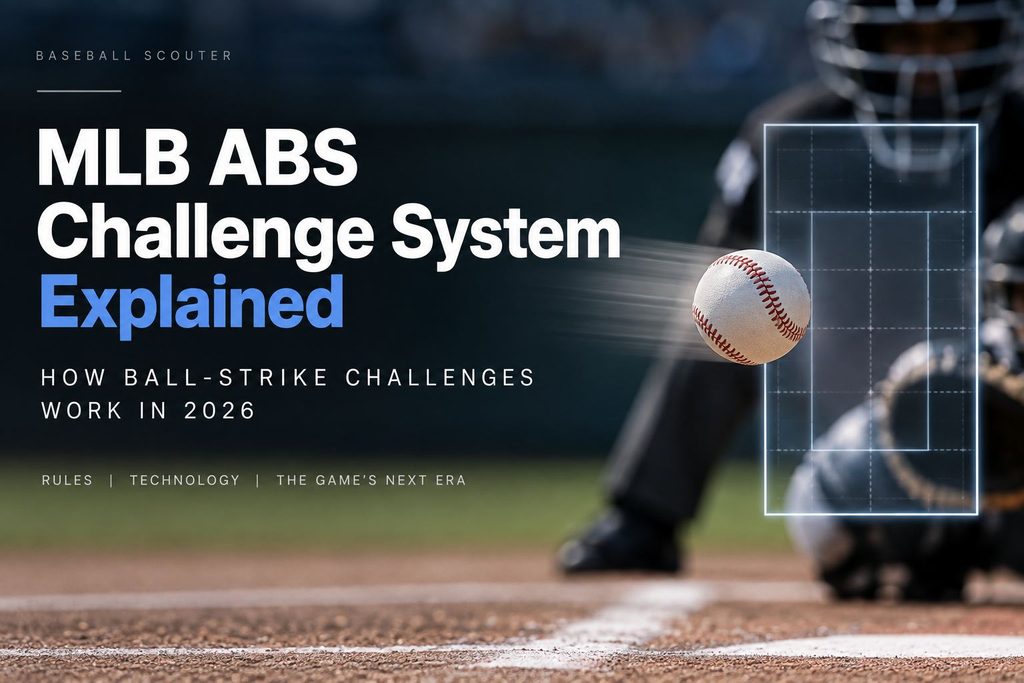
What Does the ABS Strike Zone Look Like?
MLB’s 2026 automated strike zone has a precise mathematical definition.
It is a two-dimensional rectangle measured at the midpoint of home plate.
The zone is:
- 17 inches wide
- 53.5% of the batter’s measured height at the top
- 27% of the batter’s measured height at the bottom
If any part of the baseball touches the edge of that zone at the measurement point, ABS considers it a strike.
The width is the same for every hitter, but the vertical boundaries vary with the player’s measured height.
This is also different from some earlier experimental versions of ABS that used a three-dimensional zone.
Human Umpire vs. Full ABS vs. ABS Challenge System
| System | Original call | Technology | Challenge needed |
|---|---|---|---|
| Traditional umpiring | Umpire | No | No |
| Full ABS | Automated system | Every pitch | No |
| MLB ABS Challenge System | Umpire | Challenged pitches | Yes |
MLB’s system therefore preserves traditional plate umpiring while providing a technological check on disputed calls.
What Did MLB Learn From ABS Testing?
MLB tested the challenge system extensively before introducing it to the Major Leagues.
During 288 Spring Training games in 2025:
- 52.2% of challenges resulted in overturned calls
- Games averaged 4.1 challenges
- The average challenge took 13.8 seconds
- Catchers succeeded on 56% of challenges
- Hitters succeeded on 50%
- Pitchers succeeded on 41%
These results are useful because they show that players were not simply challenging obviously incorrect calls. Almost half of the challenged calls were confirmed.
They also show that the review itself was relatively quick.
What Happened in MLB’s First ABS Challenges?
The first regular-season ABS challenge occurred on March 25, 2026, when Yankees shortstop José Caballero challenged a called strike against Giants pitcher Logan Webb.
ABS confirmed that the pitch was a strike, so the umpire’s original call stood.
The first successful challenge came the following day.
Mets catcher Francisco Alvarez challenged a pitch that had been called a ball during an at-bat by Oneil Cruz. ABS showed that the pitch clipped the strike zone.
The call was overturned, turning what would have been a walk into strike three.
These early examples demonstrate both sides of the system: sometimes ABS confirms the umpire was right, and sometimes it changes the result of an at-bat.
How Does ABS Affect Catcher Framing?
The challenge system does not eliminate catcher framing.
Because the plate umpire still makes the initial call, receiving and presentation can still influence pitches that are never challenged.
However, framing cannot preserve an incorrect call if an eligible player recognizes the mistake and successfully challenges it.
Catchers also have a new responsibility: deciding when a call is worth challenging.
Interestingly, catchers had the highest challenge success rate during 2025 Spring Training at 56%.
How Does ABS Affect Pitchers and Hitters?
For pitchers, ABS provides a way to challenge a called ball when they believe the pitch caught the automated zone.
For hitters, the same system works in reverse. A batter who believes a called strike missed the zone can challenge it.
This can become especially important in high-leverage counts.
A successful challenge could change:
- Strike three into another pitch
- Ball four into a strikeout
- A hitter reaching base into an out
- Whether an inning continues
That makes strike-zone recognition part of ABS strategy. Players need to decide almost immediately whether a borderline call is wrong enough to risk a challenge.
Does ABS Slow Down Baseball?
ABS challenges create brief interruptions, but MLB’s test data gives us a better measure than simply saying the system is “fast” or “slow.”
During 2025 Spring Training, the average challenge took 13.8 seconds, with an average of 4.1 challenges per game.
MLB also requires players to challenge immediately rather than waiting for the dugout to review video, helping keep the process short.
Does ABS Replace MLB Umpires?
No.
Home-plate umpires continue to make the initial ball-strike calls and handle the rest of their normal responsibilities.
ABS has a much narrower job:
It determines the result of a ball-strike call only when an eligible player challenges it.
So “robot umpire” remains a popular nickname, but it does not accurately describe MLB’s 2026 system.
Frequently Asked Questions
Does MLB use robot umpires in 2026?
MLB uses the ABS Challenge System, not full robot umpiring. Human plate umpires make the initial call, and eligible players can challenge selected ball-strike decisions.
How many ABS challenges does each team get?
Each team begins with two challenges. Successful challenges are retained; unsuccessful challenges are lost.
Who can challenge a ball or strike?
Only the batter, pitcher, or catcher can initiate a challenge.
How wide is the ABS strike zone?
The automated zone is 17 inches wide. Its upper boundary is 53.5% of the batter’s measured height and its lower boundary is 27%.
Does ABS eliminate catcher framing?
No. Human umpires still make the original calls, so framing can still matter on pitches that are not successfully challenged.
How long does an ABS challenge take?
During MLB’s 2025 Spring Training testing, an ABS challenge took an average of 13.8 seconds.
Final Takeaway
MLB’s ABS system is not about replacing the home-plate umpire.
Beginning in 2026, the umpire still makes the ball-strike call, but the batter, pitcher, or catcher can challenge it. Hawk-Eye then determines whether the call should stand.
After years of testing full automation and challenge-based systems, MLB chose a middle ground: keep the human umpire, but give players a fast technological way to correct disputed ball-strike calls.